Nature
 PUBLISHED


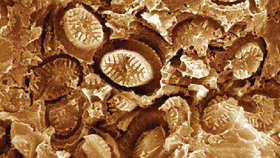


In the midst of a climate crisis, learning from warming events in Earth’s history has never been more pressing, but accurately interpreting the fossil record is crucial. Now, the discovery of “ghost" fossils has revealed that a type of plankton that was thought to have disappeared during three Jurassic and Cretaceous warming events (94, 120, and 183 million years ago, respectively) was actually there all along. How do we know? We found its imprints.
Published in Science, the new-to-science type of fossilization reveals “ghosts” of the single-celled plankton known as coccolithophores, which are an important carbon sink that can be found in the ocean to this day. Coccolithophores and their calcareous plates, known as coccoliths, were thought to have disappeared from the fossil record during what’s estimated to have been some of Earth’s hottest chapters.
However, the discovery of ghost fossils has given scientists a new and more accurate way of looking for evidence of/for coccoliths by looking not just for their remains, but also their imprints on other fossilized materials.
“The discovery of these beautiful ghost fossils was completely unexpected,” said Dr Sam Slater from the Swedish Museum of Natural History in a statement. “We initially found them preserved on the surfaces of fossilized pollen, and it quickly became apparent that they were abundant during intervals where normal coccolithophore fossils were rare or absent – this was a total surprise!”

- Microscopic plankton cell-wall coverings preserved as “ghost” fossil impressions, pressed into the surface of 183-million-year-old organic matter. Image credit: S.M. Slater, P. Bown et al., Science 2022
Imagine the soft, squishy sediments on the seafloor. In that soup of microscopic detritus exists coccolithophores, covered in coccoliths, drifting alongside spores, pollen, and other organic matter.
Over time that soft sediment began to harden into rock crushing all of its inhabitants closer and closer together. The coccoliths left their mark on surrounding organic materials during the squeeze, but some were later dissolved by acidic fluids that washed through the rock.
The coccoliths were gone, but their impressions endured, and we’ve finally found them. It’s worth noting that these imprints are small. Like, one-fifteenth of the width of a human hair small, so finding them is quite the feat indeed.
“The ghost fossils show that nannoplankton were abundant, diverse, and thriving during past warming events in the Jurassic and Cretaceous, where previous records have assumed that plankton collapsed due to ocean acidification,” explained Professor Richard Twitchett from London’s Natural History Museum.
“These fossils are rewriting our understanding of how the calcareous nannoplankton respond to warming events.”
This new understanding of the way this plankton responded to ocean warming in the past can now be applied to Earth’s future, as we try to accurately model what’s going to happen as sea temperature continues to climb.
“Our study shows that algal plankton were abundant during these past warming events and contributed to the expansion of marine dead zones, where seafloor oxygen levels were too low for most species to survive,” concluded Slater.
“These conditions, with plankton blooms and dead zones, may become more widespread across our globally warming oceans.”