Nature
 PUBLISHED


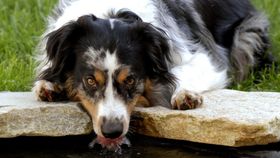


There are scientific reasons why dogs make a mess when they drink. As animals adapted to biting they lack full cheeks, which is important as it stops them from creating suction like we do, meaning they have to lap up water. Also, dogs are useless with straws.
The process has been observed in slow motion before, but a team from Virginia Tech was able for the first time to produce a physical model showing exactly how dogs drink. By quickly hitting the water with their tongue and then retracing it, they generate a column of water that they can easily close their mouth around.
The team recorded tongue motion and measured the height of the water column. Large dogs accelerate their tongues to around 4 g (four times Earth’s gravitational acceleration), and smaller dogs to about 2 g. The researchers used slow-motion cameras and laboratory simulations to understand how the fluid is raised. A dog drinking might appear messy in our eyes, but in fact every action is quick and precisely timed.
One of the dogs in the experiment being filmed while drinking. By Gart et al. PNAS
Dogs quickly plunge their tongues in the water, curling them towards their lower jaws. After hitting the water, they quickly retract them, as a water column rises directly into their mouth. The team compared this approach with how cats drink. Although the jaws of cats and dogs are similar, their drinking approaches are completely different.
Cats lightly touch the surface of the water with their tongues. The liquid adheres to the tongue and it is lifted up into the feline’s mouth. The movement is very precise, carrying a small amount of water. For dogs, the movement is rapid, and when they bite the water column the tongue is still curled, which leads to splashing.
Virginia Tech: Dog drinks water from VirginiaTech on Vimeo.
"This was a basic science study to answer a question very little was known about – what are the fundamental mechanics of how dogs drink?" said Sean Gart, lead author of the study, in a statement.
"Cats tend to be viewed as neater, dogs as messier, but dogs really have to accelerate their tongues to exploit the fluid dynamics of the water column."
These results are published in the Proceedings of the National Academy of Sciences.