Nature
 PUBLISHED


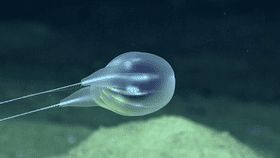


It’s a popular adage that humankind knows more about the surface of the Moon than we do about the bottom of the ocean, so it’s perhaps unsurprising that every now and then the bathyal zone spits up a surprise. New research published in the journal Plankton and Benthos Research describes the moment a team of ocean scientists from the National Oceanic Atmospheric Administration (NOAA) came across a bizarre new species off the coast of Puerto Rico. The alien-like creatures were discovered to be a new species of comb jelly, a group of animals that despite their similarities are not closely related to jellyfish. Also known as ctenophores (with a silent 'c'), comb jellies move by pumping eight rows of comb-like cilia that refract light causing a colorful display as they beat through the water. They are carnivorous animals that feed on small arthropods and larvae.
The new species discovered by the NOAA Fisheries research team has been named Duobrachium sparksae, and was found via the Deep Discoverer, a remotely operated vehicle (ROV). Using the high-definition footage captured by the ROV, scientists safely on dry land were able to inspect the new creature, and its identification as a novel species marks the first time NOAA scientists have described and annotated a new species using just ROV footage. You can witness the moment they realized they were looking at something unknown to science in the video below (from 1:28 onwards).
The high-resolution images captured by the Deep Discoverer are able to measure structures less than a millimeter, and while there are no samples to observe under a microscope the ability to avoid using samples for identifying a comb jelly has its perks.
“We didn’t have sample collection capabilities on the ROV at the time,” said NOAA Fisheries scientist Allen Collins in a statement. “Even if we had the equipment, there would have been very little time to process the animal because gelatinous animals don’t preserve very well; ctenophores are even worse than jellyfish in this regard. High-quality video and photography were crucial for describing this new species.”

As well as allowing the scientists to review minute details of the comb jellies, they were also able to observe some unusual behaviors from the footage. They had long tentacles which aided them to drift across the sea bed a bit like a hot air balloon attached to the floor with two lines. Whether or not these tentacles were actually attached to the floor wasn’t clear, but they were able to maintain a specific height above the seafloor, implying they may at least be touching the seabed.
“We’re not sure of their role in the ecosystem yet,” said NOAA Fisheries scientist Mike Ford. “We can consider that it serves similar roles to other ctenophores near the ocean floor and it also has some similarities to other ctenophores in open ocean areas. We saw the species three times in a relatively small area; hopefully, that means they’re not extremely rare.”