Space and Physics
 PUBLISHED


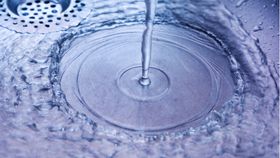


When you're at your kitchen sink, you may have noticed that the water from the faucet splays as it falls, creating a roundish raised rim. This phenomenon is called a hydraulic jump and was first documented by Leonardo da Vinci in the 1500s. Now, it has finally got a complete explanation.
As reported in the Journal of Fluid Mechanics, the phenomenon is not actually caused by gravity, as it has been believed since the 1820s. Hydraulic jumps are caused by the surface tension and the viscosity of water. PhD student and lead author, Rajesh Bhagat from the University of Cambridge, has managed to demonstrate this in two ways.
First, he shot jets of waters upwards and sideways at flat surfaces, which reproduced the same circular pattern seen in the “regular” downward jet. He then adjusted both surface tension and viscosity, successfully predicting the size of the hydraulic jumps regardless of the direction they were shot at, instead depending on his changes.
“His experiments and theory show that the surface tension of the liquid is the key to the process and has this has never before been recognized, even though the problem was discussed by da Vinci and many others since,” co-author Professor Paul Linden said in a statement.
“This work represents a remarkable achievement in our understanding of the dynamics of thin layers of fluid.”
While hydraulic jumps do not create any major issues in household sinks and baths, they can become problematic in deeper water, creating violent waves, whirlpools, and turbulence. Though some industries already use hydraulic jumps for energy dissipation below spillways and outlets, those that have a high level of water consumption could really benefit from having such control over these water systems. Although Bhagat hopes that applications of this discovery could help reduce water use in normal households too.
“Knowing how to manipulate the boundary of a hydraulic jump is very important, and now with this theory we can easily extend or reduce the boundary,” Bhagat explained.
"Understanding this process has big implications and could reduce industrial water use dramatically. The new theory is already being used in practical work in the Chemical Engineering department. People can use this theory to find new ways to clean everything from cars to factory equipment."