Space and Physics
 PUBLISHED



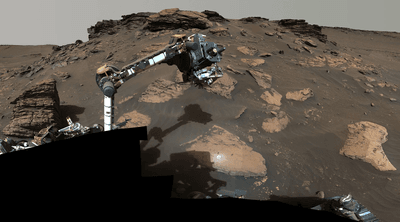


NASA’s Perseverance has spent 1,063 days on Mars exploring the rocks and structures of Jezero Crater and its river delta. It has been collecting samples to be sent to Earth and analyzing rocks. But for over a month, one of its instruments has not been working, and mission specialists have not yet been able to solve the problem.
One of the most intriguing instruments on Perseverance is SHERLOC, a bulky backronym for Scanning Habitable Environments with Raman & Luminescence for Organics & Chemicals. The instrument uses lasers to hit interesting targets, and its camera and spectrometers use the hit of the laser to look for water-altered minerals and organics. The holy grail of this quest is a biosignature, evidence of life (past or extant) on Mars.
The instrument has already provided important insights into the Red Planet. Unfortunately, on January 6, one of the two covers that protect the instrument from dust wouldn’t open. Since then, engineering approaches have been successful at partially opening it, but the team is still at work to understand what has happened to cover and how they might fix it for good.
The mechanical problem has partially disabled SHERLOC. It can take images through its WATSON (Wide Angle Topographic Sensor for Operations and eNgineering) camera, but laser scanning and spectrometry were performed through the aperture that is not fully opening now.
SHERLOC is not the only instrument on Perseverance, so even if the team can’t find a solution this is not the end of the mission. The rover has six other instruments and they are all working fine. Some of the instruments have overlapping capabilities.
Perseverance has recently lost its exploration companion, the little helicopter Ingenuity. A flight malfunction led to a broken rotor, and so the first flying vehicle on another world was set down for good.