Space and Physics
 PUBLISHED
 3
3



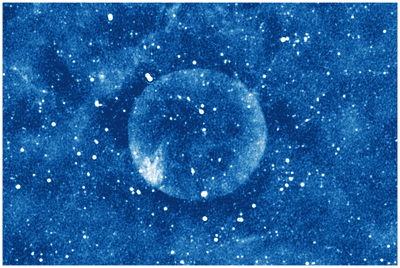


Regular geometrical shapes are such a common feature in human civilizations that we often don’t realize that they are not that common in nature. But then you see a perfect sphere of plasma in the depths of space, and, well, that is certainly strange.
An international team of astronomers led by Professor Miroslav Filipović from Western Sydney University has dubbed this object Teleios, from the ancient Greek word for perfection. And it is indeed a perfect sphere, which really challenged the scientists in understanding how it came to be.
The sphere was discovered in the Australian Square Kilometre Array Pathfinder (ASKAP) Evolutionary Map of the Universe (EMU). It is only visible in radio waves, which allowed the team to find a very likely culprit. This was formed by the explosion of a supernova. So far, so good. But things soon got puzzling.
The supernova remnant is not only almost perfectly symmetric, but it has one of the lowest surface brightnesses of all known supernova remnants in the Milky Way. The team has come up with multiple scenarios to explain what they are seeing.
The initial suspicion was that this was a supernova explosion from a type Ia... But way too many other things are questioning this idea.
Professor Miroslav Filipović
This might be a young supernova remnant, maybe less than 1,000 years old, located around 7,000 light-years away. That could be the case because early on in the so-called Sedov phase, the explosion that ripped a star apart is roughly symmetrical.
It is also possible that the supernova remnant is a lot older, at a later Sedov phase, and much further away, around 25,000 light-years away. In that scenario, the symmetry is only possible if the expanding shell of material has encountered very little interstellar stuff. And then some!
“The Sedov phase in a supernova remnant (SNRs) can last for a few tens of thousands of years. It is not just that we need a rarified environment, but it must also have a constant density across the entire region of the SNR expansion. That is quite tricky to achieve,” Professor Filipović told IFLScience.
But maybe it is not a standard supernova explosion at all. Researchers considered a type Ia supernova where a white dwarf steals material from a companion until it passes a threshold and ends up exploding it. Or even a type Iax when the supernova doesn’t completely annihilate the white dwarf and leaves behind a zombie star. None of these scenarios perfectly fit the observations, unfortunately.
“The initial suspicion was that this was a supernova explosion from a type Ia... But way too many other things are questioning this idea, as we also think it could be a bit smaller in size and therefore a younger (and less energetic) type Iax? Our new and upcoming observations with MeerKAT might solve this mystery,” Professor Filipović told IFLScience.
The work has been submitted to the Publications of the Astronomical Society of Australia and is available on the ArXiv.