Space and Physics
 PUBLISHED
 6
6



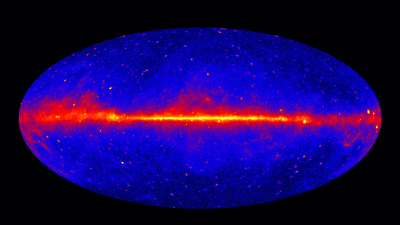


Looking towards the central region of the Milky Way, there is an unexpected surplus in the most powerful light that exists: gamma rays. The source of this gamma-ray excess is uncertain. Two hypotheses have been put forth. One possibility is that dark matter particles collide with each other there and emit gamma rays. Alternatively, known gamma-ray emitters like pulsars or even supermassive black holes might be responsible for it.
Dark matter is a fundamental hypothesis when it comes to our understanding of the universe, but it remains a hypothesis. We have yet to prove its existence, so the alternative hypotheses have had a bit of an edge, since we know that pulsars exist, even though the expected number from the excess is much higher than the known ones.
New work is now balancing the scales again, thanks to sophisticated supercomputer simulations of the expected distribution of dark matter in the center of the Milky Way. They were able to simulate the possible collisions of dark matter particles with better precision than before, and the map that was produced by this computer is consistent with what was seen by the Fermi Gamma-ray Space Telescope.
“Dark matter dominates the universe and holds galaxies together. It’s extremely consequential and we’re desperately thinking all the time of ideas as to how we could detect it,” co-author Joseph Silk, a Johns Hopkins professor of physics and astronomy, said in a statement sent to IFLScience. “Gamma rays, and specifically the excess light we’re observing at the center of our galaxy, could be our first clue.”
Now, this matching is not a confirmation that this is dark matter, but it does make the case that just because we do not know what dark matter is, we can’t dismiss its potential contribution to the gamma-ray excess.
The team is working on a new test for the excess. They are producing a map of what the gamma-ray emissions from several dwarf galaxies that orbit the Milky Way should look like. When the currently under-construction Cherenkov Telescope Array comes online, it will produce higher-resolution views of the gamma-ray sky, and hopefully allow us to understand the source of the signal.
“It’s possible we will see the new data and confirm one theory over the other,” Silk said. “Or maybe we’ll find nothing, in which case it’ll be an even greater mystery to resolve.”
A paper describing the work is published in the journal Physical Review Letters.