Space and Physics
 PUBLISHED



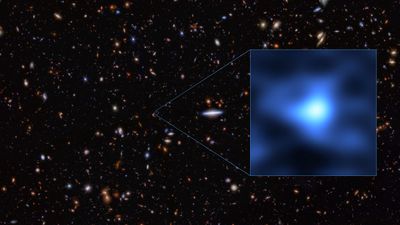


The most distant and earliest known galaxy is called JADES-GS-z14-0 and its light comes from when the universe was less than 300 million years old. The object itself is much smaller than our galaxy but it is a powerhouse of star formation, and now two different teams of scientists have detected oxygen in it, the farthest detection of this atom yet.
Finding oxygen is a big deal. Only hydrogen and helium (with a sprinkle of lithium) formed in the Big Bang. All the other heavier elements formed thanks to stars. Oxygen is formed when evolved stars fuse helium and not just hydrogen. The presence of oxygen shows that this very early galaxy was a lot more evolved than previously thought.
“It is like finding an adolescent where you would only expect babies,” first author of the first paper, Sander Schouws, a PhD candidate at Leiden Observatory, explained in a statement. “The results show the galaxy has formed very rapidly and is also maturing rapidly, adding to a growing body of evidence that the formation of galaxies happens much faster than was expected."
The galaxy was only discovered by JWST last year but it was following up with the Atacama Large Millimeter Array (ALMA) that found how chemically mature this galaxy actually is. It turns out, JADES-GS-z14-0 has 10 times more heavy elements than expected.
“I was astonished by the unexpected results because they opened a new view on the first phases of galaxy evolution,” explained Stefano Carniani of the Scuola Normale Superiore of Pisa, lead author of the second paper. “The evidence that a galaxy is already mature in the infant Universe raises questions about when and how galaxies formed.”
The data from ALMA also helped refine the age of this galaxy: 294 million years after the Big Bang. JADES-GS-z14-0 is bright, so it's expected that even the most distant observations might be possible in the coming year.
Gergö Popping, an ESO astronomer at the European ALMA Regional Centre who did not take part in the studies, added: "I was really surprised by this clear detection of oxygen in JADES-GS-z14-0. It suggests galaxies can form more rapidly after the Big Bang than had previously been thought. This result showcases the important role ALMA plays in unraveling the conditions under which the first galaxies in our Universe formed."
The studies are published in The Astrophysics Journal and Astronomy & Astrophysics.