Space and Physics
 PUBLISHED
 2
2


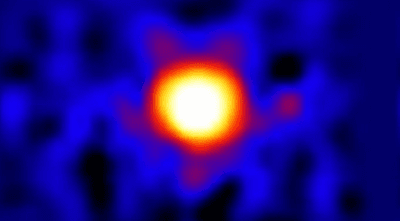


Sagittarius A*, the supermassive black hole (SMBH) at the center of our galaxy, is not as placid as previously thought, new observations with the JWST reveal. Instead, the surrounding accretion disk is flaring almost constantly, with small flares occurring every few seconds, and larger ones several times daily.
Famously, light cannot escape black holes, particularly the supermassive sort at the center of galaxies. However, the accretion disks around SMBHs can be tremendously bright. Some SMBHs are “actively feeding” and produce immense amounts of light as they consume former stars or clouds of gas. Sagittarius A* is considered quiet by comparison, but some of that impression could just be because of the obstruction provided by all the stars and dust blocking our view.
Infrared radiation is less affected by this interference, but infrared telescopes are in such short supply we’ve only just started to study flares from the area in infrared. That makes the JWST the prime instrument for observing our galaxy’s heart. Professor Farhad Yusef-Zadeh of Northwestern University led a team that observed Sagittarius A* for a total of 48 hours, the longest observations of the galactic center yet taken by the JWST. The seven blocks over the course of a year allowed the team to compare the black hole’s flaring both minute to minute and months apart.
“Flares are expected to happen in essentially all supermassive black holes, but our black hole is unique,” Yusef-Zadeh said in a statement. “It is always bubbling with activity and never seems to reach a steady state. We observed the black hole multiple times throughout 2023 and 2024, and we noticed changes in every observation. We saw something different each time, which is really remarkable. Nothing ever stayed the same.”
“In our data, we saw constantly changing, bubbling brightness,” Yusef-Zadeh said. “And then boom! A big burst of brightness suddenly popped up. Then, it calmed down again. We couldn’t find a pattern in this activity. It appears to be random. The activity profile of the black hole was new and exciting every time that we looked at it.”
The team used the JWST’s NIRCam instrument, which takes observations at 2.1 and 4.8 microns simultaneously, like a camera that can collect red and blue light but not colors in between. To the team’s surprise, flares started at the shorter wavelength 3-40 seconds before the longer one.
“This is the first time we have seen a time delay in measurements at these wavelengths,” Yusef-Zadeh explained.
These large explosions occur five to six times a day, and while the team do not know their cause, they think they involve a separate process from the shorter outbursts. On the other hand, what the team calls “subflares” preceded the brightest flares and might be used to predict them.
Like the Sun, the accretion disk is plasma, which turbulence can compress so that there is a brief modest upsurge in radiation. Yusef-Zadeh compares this to a solar flare, magnified by Sagittarius A*’s vast scale.
The team thinks the brighter, longer flares are magnetic reconnection events, when interactions between magnetic fields release particles accelerated to near the speed of light. “A magnetic reconnection event is like a spark of static electricity, which, in a sense, also is an ‘electric reconnection,’” Yusef-Zadeh said.
The delay between wavelengths could be explained if particles released in the flare lose energy during the process, since lower energies radiate at longer wavelengths. That’s what happens to charged particles spiraling within magnetic fields, but it’s too soon to be certain this is the cause.
The speed of light means that changes in brightness that occur over large areas can’t happen quickly. The team noted some increases in flux density during big flares including doubling in two minutes or less, placing a maximum size on the areas responsible for the flares.
The team has sought permission to observe Sagittarius A* with the JWST for a full 24 hours to reduce noise, but given the immense competition for the mighty telescope’s time, the application’s success remains uncertain. If the time is allocated, Yusef-Zadeh said, “We also can see if these flares show periodicity (or repeat themselves) or if they are truly random.”
The study is open access in the Astrophysical Journal Letters.