Nature
 PUBLISHED
 1
1



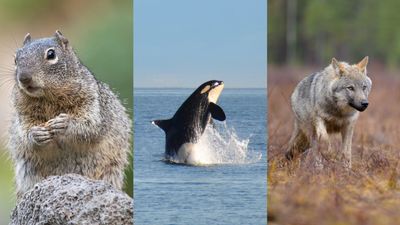


Just when we think we’ve got something of a grip on our animal knowledge, we come across a new piece of information that throws us for a loop. Sometimes it’s their bizarre toilet habits, other times it’s the unconventional ways they travel, but some of the most interesting ways we’ve been surprised have been to do with what animals end up snacking on.
Orcas vs. moose
Who would win in a fight between an orca and a moose? It sounds like something that’s unlikely to happen; one’s a marine mammal, the other a land mammal. Turns out, though, moose love a dip in the water – and in 1992, that saw one land in the jaws of some orcas.
That’s according to research presented back at the Third Glacier Bay Science Symposium in 1993, which discussed the feeding behaviors of orcas in Southeastern Alaska. In one reported feeding event from the previous June, it’s alleged that a pod of four orcas swimming just off the shore of Pleasant Island ate a moose. Another, smaller moose had been present in the water at the same time and managed to escape to a nearby kelp bed, but it later drowned there. Not a fun day to be a moose.
It’s important to note that while this report was discussed at a scientific conference, it’s anecdotal, which means that it’s not as reliable as something that has been thoroughly scientifically documented. Even if we knew for sure that it did happen, munching on moose doesn’t seem to be a regular behavior for orcas.
“Whatever prompted the killer whales to attack the moose that day, it seems to be a one-off occasion,” Emma Luck, a marine biologist who specializes in Alaskan marine mammals, explained in a Facebook post. “Killer whale research has expanded greatly since then, and despite the subsequent three decades of observation and study up and down the west coast of North America, no other records of killer whales eating moose have been identified.
“It’s safe to say that killer whales are most certainly not a major predator of moose!” she concluded.
Wily wolves
Survival in the wild often involves knowing how best to manage your energy, so if an opportunity for food that requires minimal effort presents itself, you’re probably going to take it. Wild wolves in British Columbia have been doing so in a particularly creative way.
Back in 2021, the coast near Bella Bella had a problem – an invasion of European green crabs. In an effort to tackle the swarms, Indigenous Haíɫzaqv Nation Guardians placed crab traps along the shore and in the water, hoping to lure the invaders in with a tasty bait of herring and, later, Steller sea lion carcass too.
But in 2023, the traps were repeatedly raided and damaged. Who was the culprit? It was hard to know for sure, but given that the traps were in deeper water, it was assumed that wolves could be ruled out in favor of carnivorous marine mammals like seals or otters.
You know what they say about assumptions though. When remote cameras were set up, a thief was caught in the act – a female wolf, who swam out to a buoy attached to a crab trap line, came back to shore with it, and then pulled the trap out of the water by the line using her mouth. Then, she cracked open the bait cup and feasted on its contents.
The same behavior hasn’t been recorded since, and there’s some debate over whether or not it counts as tool use too – it’d be a first for wolves if so – but it’s impressive nonetheless. It seems even apex predators might fancy the odd break from hunting.
Ground squirrels gone omnivorous
California ground squirrels are little grain-and-nut-loving cutie patooties, right? Well, yes – but in 2024, scientists also discovered an unexpectedly bloodthirsty element to their diets.
We say unexpected – some squirrels are well known to be opportunistically omnivorous, munching on things like insects and other small animals when circumstances require. The California ground squirrel, however, was thought of as a granivorous species.
So when a team of undergraduate students from the University of California, Davis, captured the small rodents actively hunting down, killing, and eating voles in Briones Regional Park during the summer months, it’s safe to say they were pretty surprised.
“I could barely believe my eyes,” said study author Sonja Wild, a postdoctoral research fellow in the UC Davis Environmental Science and Policy department, in a statement, recalling when the students showed her the video evidence for the first time. “From then, we saw that behavior almost every day. Once we started looking, we saw it everywhere.”
During the same period that this behavior was spotted, there’d also been an uptick in vole numbers at the park. Wild and the team believe the squirrels’ newly discovered hunting behavior may have been a response to this, and an indicator that we should start thinking of them as opportunistic omnivores instead – something that could end up serving them well.
“The fact that California ground squirrels are behaviorally flexible and can respond to changes in food availability might help them persist in environments rapidly changing due to the presence of humans,” said Wild.
The possible wider implications of this behavior remain unclear, but as it – and the unconventional feeding habits of orcas and wolves – shows, what we know about how our fellow animals live and eat appears to only be the tip of the iceberg.
“Squirrels are one of the most familiar animals to people. We see them right outside our windows; we interact with them regularly,” said lead author Jennifer E. Smith. “Yet here’s this never-before-encountered-in-science behavior that sheds light on the fact that there’s so much more to learn about the natural history of the world around us.”