Space and Physics
 PUBLISHED
 5
5




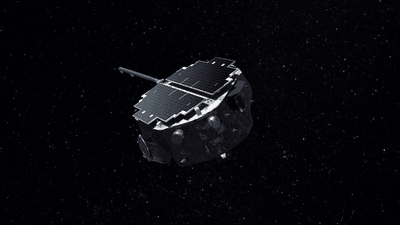


The boundary of the Solar System remains somewhat poorly understood. We know we are within it, in a region of space called the heliosphere, where particles released by the Sun dominate. Beyond it, the flow of particles from interstellar space rules. Between the two, where the heliosphere meets interstellar space, are the heliopause and the bow shock. A new NASA mission is set to provide crucial insight into both.
Launched last September, it’s called the Interstellar Mapping and Acceleration Probe (IMAP), and just a couple of weeks ago it reached its final location, a region in space called Lagrange point 1 (L1). This is about 1.5 million kilometers (just under 1 million miles) from Earth, directly towards the Sun. It’s the location where the Sun and Earth’s gravity cancel out, so that the telescope will move around our star in one year.
Close to the center of the Solar System might seem like a peculiar location to study its edges, but the secret of IMAP is that it is designed to study the radiation coming from the heliopause and bow shock.
When the solar wind slams into particles from the interstellar medium, it produces energetic neutral atoms (ENAs). By studying these atoms, IMAP can tell us things about the region and its variability, such as how its shape changes with the activity of the Sun.
From L1, IMAP has a 360-degree view of the heliosphere and also an unobstructed view of the Sun. The mission will also monitor space weather and can provide a 30-minute warning if harmful radiation from the Sun is coming our way.
The mission will officially start on February 1, but the spacecraft hasn't been idle. During the commission phase, the team has been testing its suite of instruments to make sure everything is working as it should. Everything is going extremely well, suggesting we may soon start unlocking the secrets of the heliosphere.
“It’s just astounding that within the first couple weeks of observations, we see such clear and consistent ENA data across the factor of 10,000 in energy covered collectively by the three imagers,” David McComas, Princeton University professor and principal investigator for the IMAP mission, said in a statement. “This, plus excellent first light data from all seven of the other instruments, makes for a 10 out of 10, A-plus start to the mission.”
So far, only two human-made objects have gone into interstellar space: Voyager 1 and Voyager 2. They measured the change in particles as they passed through the heliopause and then encountered the bowshock, the “wall of fire” after the Solar System’s boundary, where the interstellar medium slams into the heliosphere.
There has been a proposal for a mission to look at the solar system from the outside, and researchers have even worked out a way to do so, but nothing is in the works. Still, the work of IMAP might reveal insight that makes such a mission more urgent.