Humans
 PUBLISHED
 2
2




As ancient cities grew, so did inequality. To build great civilizations, people need to concentrate power – and power, almost inevitably, concentrates wealth. That's a loose observation that historians often point towards when studying the growth of urban settlements in the Neolithic Age. Weirdly, though, one of the oldest and most successful cities in the ancient world didn't play by these rules.
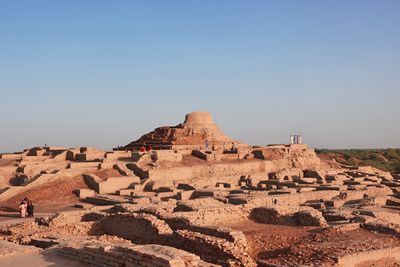
Mohenjo-daro, meaning "Mound of the Dead Men," was one of the great cities of the ancient Indus Valley Civilization, located in what is now the southwestern Pakistani province of Sindh. Built over centuries during the Bronze Age, the site sprawls for 240 hectares (593 acres), featuring a remarkably organized collection of city blocks, civic centers, public baths, cultural hubs, colleges, a great granary, and even an elaborate drainage system.
In a new study, archaeologists at the University of York mapped the growth of Mohenjo-daro as it grew between 2600 BCE and 1900 BCE, just before it was mysteriously abandoned. Surprisingly, they found that the differences between the largest and smallest homes narrowed as time went on, suggesting that the gap between the rich and poor actually shrank as the city developed.
“The overall level of economic inequality at Mohenjo-daro is lower than comparable metrics from contemporaneous early cities – but more importantly – economic inequality declined over time,” the paper concludes. “Concurrently, intense development occurred along Mohenjo-daro’s streets, suggesting a connection between the reduction of inequality and the governance of the city.”
This is very atypical of urban growth in the ancient world. Typically, early Neolithic villages were relatively egalitarian. There may have been a chief with a loyal gaggle of priestly figures and "strongmen," but most people lived in relatively similar abodes. In fact, many lived in shared, communal living arrangements with their extended families and neighbors.
At a key point in the expansion, however, collective governance gives way to centralized control. All too often, a small elite manages to seize resources and capture the flows of wealth, using that advantage to build personal fortunes. The ultimate result is palaces and great monuments on one side of the city, with the masses living in increasingly cramped slums on the other.
Ancient Egypt, for instance, is invariably associated with the Great Pyramids of Giza, flashy temples, and gold-caked burials in the modern imagination, but this is wholly unrepresentative of how most of the society lived at the time. The same goes for the Romans, the ancient Greeks, and many of the other “great” civilizations of antiquity, whose populations were overwhelmingly impoverished, living in the shadows of statues built for someone else.
So what set Mohenjo-daro apart? The researchers suggest its relatively equitable appearance may have stemmed from the unique nature of its social structure. Rather than draining the coffers on vanity projects and displays of ego, whoever was in charge spent wealth on the unglamorous infrastructure that actually improved daily life for everyone.
“While ancient Egyptians were building pyramids for god-kings, and the Greeks were constructing massive palaces at Knossos, the people of the Indus were building something entirely different,” Dr Adam Green, lead study author from the University of York’s Department of Archaeology and Department of Environment and Geography, said in a statement.
“Mohenjo-daro is often cited as being famous for what it doesn't have, such as the absence of palaces for kings, gold-filled tombs, and no statues of rulers. But what it does have is so important.”
“Instead of gold-filled tombs and huge temples, Mohenjo-daro focused on sophisticated brick-lined drains and organised street layouts. Instead of allowing the perks of society to accumulate with a tiny elite, the city’s amenities were widely distributed amongst the everyday households,” explained Dr Green.
This isn't to romanticize the city of Mohenjo-daro as some classless utopia, but the findings do suggest that societies can be organized in ways that spread their benefits more widely across the board, not into the hands of a fortunate few.
At a time when global wealth inequality has climbed to a boiling point – the top 0.001 percent of the world’s population controls three times more wealth than the entire bottom half of humanity – perhaps the ancient Indus Valley has something to teach us in the 21st century.
“It is quite an interesting lesson for modern societies, as the Indus civilisation demonstrates clearly that an urban society can be highly productive and inventive at scale, whilst also ensuring that resources and power are shared equitably. In fact, doing so may even have been essential to sustaining prosperity over the centuries,” added Dr Green.
The study is published in the journal Antiquity.