Health and Medicine
 PUBLISHED
 4
4




April 6, 1938, was one of those days which changed the world. A young research scientist, working at the chemical company DuPont to develop new types of refrigerants, instead found that a gas known as tetrafluoroethylene, or TFE, had accidentally polymerized inside one of his test tubes, resulting in a solid waxy substance with extreme heat-resistance, low surface friction, and high corrosion resistance properties.
This weird new stuff, initially called polytetrafluoroethylene, or PTFE, would pretty soon find its way into every aspect of life. It played a vital part in the Manhattan Project; it would be woven into rainproof coats and space suits; and most famously of all, it would find a place in just about every kitchen in the country. Its tradename: Teflon.
But fast-forward more than 70 years, and Teflon is no longer the miracle chemical it was once celebrated as. Today, it’s more famous as one of the many “forever chemicals” – the per- and polyfluoroalkyl substances, known more familiarly as PFASs, which are ubiquitous in our water supplies, our makeup collections, and worryingly, places like our livers or umbilical cords.
“The non-stick coating material Teflon is generally a family member of PFAS,” explained Cheng Fang, a senior research fellow at the University of Newcastle’s Global Centre for Environmental Remediation, and co-author of a recent paper revealing how potentially millions of these tiny plastic particles can be transferred from our non-stick pots and pans into our environment.
“Given the fact PFAS is a big concern, these Teflon microparticles in our food might be a health concern,” he said in a statement released last month. “[It] needs investigating because we don’t know much about these emerging contaminants.”
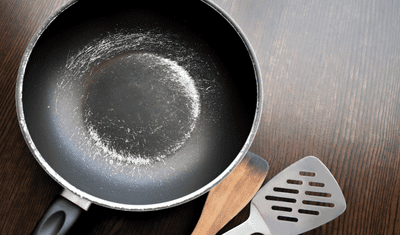
So that’s precisely what the team did. Using a technique called Raman spectroscopy, which allows chemists to identify molecules by measuring their individual vibrational structures, and applying a newly-developed algorithmic approach to detect the presence of microplastics, the researchers found that just one single crack in the Teflon coating of a pot or pan can release approximately 9,100 plastic particles. Broken coatings in general may release up to 2,300,000 microplastics and nanoplastics, the paper notes.
Those are concerning numbers. PFASs have long been known to have cancer-causing properties, as well as a whole range of other health issues. They can interfere with hormone levels, screw with our ability to feed our babies, and even reduce our immune responses against infections and viruses.
In other words, they’re not the kind of things we want littering our dinner plates. “More research is recommended to address the risk assessment of the Teflon microplastics and nanoplastics, given that Teflon is a family member of PFAS,” said Youhong Tang, a professor in the College of Science and Engineering at Flinders University, in the statement.
Until then, the study is just the latest in a series of discoveries revealing the extent to which PFASs threaten human and environmental health – a problem about which, it is becoming increasingly clear, we’re still mostly in the dark.
“[This study] gives us a strong warning,” Tang said. “[W]e must be careful about selecting and using cooking utensils to avoid food contamination.”
The study is published in the journal Science of The Total Environment.