Space and Physics
 PUBLISHED



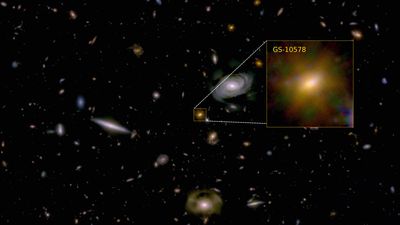


Astronomers report how a "death by a thousand blows" caused a galaxy in the early universe to stop forming stars, making it the oldest-known dead galaxy. This was during one of the most intense periods of star formation across the universe, which makes the galaxy's death particularly peculiar.
The object in question is known as GS-10578, and it is nicknamed Pablo’s Galaxy after the first astronomer who studied it in detail. It is a big galaxy, 200 billion times the mass of our Sun, and must have reached this size in a relatively brief amount of time because its light is reaching us from 11.6 billion years ago, or just over 2 billion years after the Big Bang. .
Using observations from JWST and the Atacama Large Millimeter Array (ALMA), the team estimated it took just 1 billion years for the galaxy to assemble its stars before it was interrupted by its own supermassive black hole.
Actively feeding supermassive black holes can disrupt star formation on a galaxy-wide scale by creating winds of hot plasma, dispersing the cold gas necessary for new stars to form. The team knew the galaxy was done for because they couldn't see any cold gas.
“What surprised us was how much you can learn by not seeing something,” said co-first author Dr Jan Scholtz from the University of Cambridge and the Kavli Institute for Cosmology in a statement. “Even with one of ALMA’s deepest observations of this kind of galaxy, there was essentially no cold gas left. It points to a slow starvation rather than a single dramatic death blow.”
The work reveals that, at the time of observation, hot winds from the supermassive black hole reached 400 kilometers (250 miles) per second, or fast enough to have caused the loss of about 60 solar masses of cold gas per year. The exact level of activity would have oscillated over time, but the researchers predict the whole reservoir of gas could have been pushed into interstellar space in just 16 to 220 million years; a short period for a galaxy.
“The galaxy looks like a calm, rotating disc,” said co-first author Dr Francesco D’Eugenio, also at Cambridge and the Kavli Institute for Cosmology. “That tells us it didn’t suffer a major, disruptive merger with another galaxy. Yet it stopped forming stars [some 1.6 billion years after the Big Bang], while the black hole is yet again active. So the current black hole activity and the outburst of gas we observed didn’t cause the shutdown; instead, repeated episodes likely kept the fuel from coming back.”
“You don’t need a single cataclysm to stop a galaxy forming stars, just keep the fresh fuel from coming in,” added Scholtz.
The finding helps explain the presence of other galaxies that look old before their time, at least according to our models. The combination of ALMA and JWST observations has revealed how that might come to pass.
The study is published in the journal Nature Astronomy.