Space and Physics
 PUBLISHED
 8
8





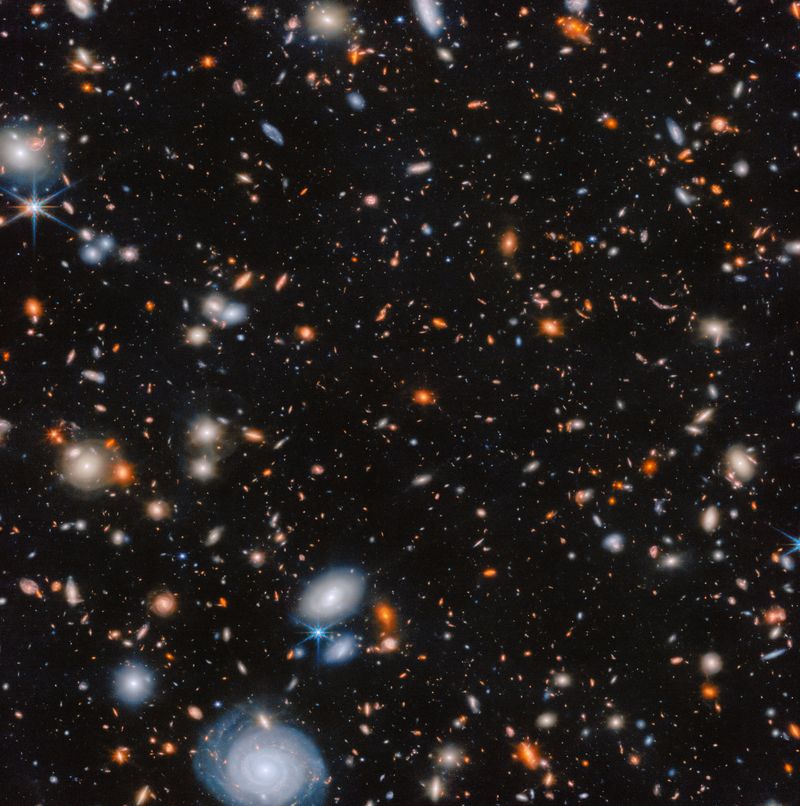
Astronomers have estimated the size and activity of a supermassive black hole discovered in one of the most distant galaxies we have ever seen. Because the speed of light is finite, looking farther into the universe is like looking farther back in time. The light from this galaxy comes from just 400 million years after the Big Bang, making this the oldest known supermassive black hole found yet.
At the time, the black hole had a mass 1.6 million times that of our Sun, about a third of Sagittarius A* which sits at the center of our galaxy, but its own galaxy, GN-z11, is a mere one-hundredth of the Milky Way.
This is another example of an overmassive black hole from the early universe, however, such a large object so early is a bit of a problem. Scenarios put forward to explain supermassive black holes include that they may have formed from a "light seed" – a truly massive star going supernova, forming a sizable black hole that then grows supermassive – or a "heavy seed" scenario which sees a supermassive black hole form directly from gas clouds, 10,000 to 100,000 times the mass of the Sun. The latter would fit better with data from this galaxy, but the black hole's activity makes it less clear-cut.
“It’s very early in the universe to see a black hole this massive, so we’ve got to consider other ways they might form,” lead author Roberto Maiolino, from Cambridge’s Cavendish Laboratory and Kavli Institute of Cosmology, said in a statement sent to IFLScience. “Very early galaxies were extremely gas-rich, so they would have been like a buffet for black holes.”
Recent data from JWST has pushed a preference towards the "heavy seed" scenario, but it is not clear which scenario would work best for this particular supermassive black hole, and that’s because of the incredible accretion of material it is undergoing. The balance between the gravitational pull of an object and the pressure from the radiation (light) created by said object is called the Eddington limit. Above this limit, things are broken apart, below they collapse.
Supermassive black holes don’t emit light but the material that surrounds them does. As it spins around ready to be eaten, this material experiences incredible gravitational forces. It heats up, releasing incredible energy. Supermassive black holes are extreme objects and they can overcome the Eddington limit. In the case of the supermassive black hole at the core of GN-z11, the rate of accretion (and associated light) is five times the Eddington limit.
The team is not convinced that this extreme feeding has been constant since its formation, but if it was, it would allow for the "light seed" scenario to be possible. The team hopes that the discovery of even more distant black holes might help disentangle the scenarios: do they start out large or do they grow really fast?
A paper describing the research is published in Nature.