Space and Physics
 PUBLISHED
 1
1





A team studying asteroids using CERN’s Super Proton Synchrotron (SPS) proton beam has found a few complications with the idea of deflecting a large space object using a nuclear blast.
Though NASA believes we are safe from all known asteroids for the next century at least, it remains a possibility that Earth could one day face a threat from a large chunk of space rock heading in our direction. To this end, the US space agency, among others, has been looking into ways we could alter the course of a potentially threatening object, or else break it apart altogether.
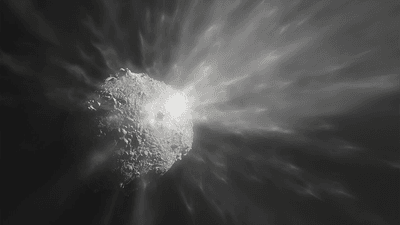
In 2022, NASA slammed a spaceship into asteroid Dimorphos – which is around the size of the Great Pyramid of Giza – in an attempt to alter its course. While the mission successfully redirected the asteroid, the distribution of debris it produced left a few mysteries to sort out.
"We saw that the boulders weren't scattered randomly in space," Tony Farnham, lead author of a 2025 paper on the topic, said in a statement. "Instead, they were clustered in two pretty distinct groups, with an absence of material elsewhere, which means that something unknown is at work here."
In a situation where Earth is really under threat, that could be a problem.
"If an asteroid was tumbling toward us, and we knew we had to move it a specific amount to prevent it from hitting Earth, then all these subtleties become very, very important," second author Jessica Sunshine added. "You can think of it as a cosmic pool game. We might miss the pocket if we don't consider all the variables."
So, what about nuking asteroid threats? This option is considered a last resort due to the possibility of fragmentation. In short, while it's not great to have a giant asteroid screaming toward you, it's also not great to have a whole pile of smaller rocks screaming toward you in its place.
In the new study, the team subjected a sample of the metal-rich Campo del Cielo meteorite to 27 high-energy pulses of the 440 gigaelectronvolt SPS proton beam, in order to recreate impact conditions and measure their effects. While not necessarily bad news for those who want a real-life Armageddon, the meteor sample didn't quite act how one would expect.
“The material became stronger, exhibiting an increase in yield strength, and displayed a self-stabilising damping behaviour,” Melanie Bochmann, co-team lead, explained in a statement.
"These results suggest that high-energy proton irradiation not only hardens iron meteorite material but may transform it into a composite-like structure with improved damping characteristics," the team added in their paper.
In short, the meteorite held together a lot better than expected. While making a potentially-deadly asteroid stronger doesn't sound like a particularly good idea, the goal is not to shatter it apart, but to deflect it onto a safe course for Earth. On that front, this may actually be good news.
“Our experiments indicate that – at least for metal-rich asteroid material – a larger device than previously thought can be used without catastrophically breaking the asteroid," Bochmann added. "This keeps open an emergency option for situations involving very large objects or very short warning times, where non-nuclear methods are insufficient and where current models might assume fragmentation would limit the usable device size.”
Before that, further study is needed. The meteorite sample has now been transferred to the ISIS Neutron and Muon Source at the Rutherford Appleton Laboratory in the UK, where it will receive neutron diffraction and positron annihilation lifetime spectroscopy measurements.
“These analyses are intended to examine changes in the meteorite’s internal structure caused by the irradiation and to confirm, at a microscopic level, the increase in material strength by a factor of 2.5 indicated by the experimental results,” Bochmann explained.
While an interesting and useful analysis, further study of asteroids up close will be pivotal for dealing with potential threats. NASA and ESA are planning on studying asteroid Apophis as it makes its closest approach to Earth in 2029, observing how it is affected by our planet's gravity. Other types of asteroid will need to be studied as well.
“In our first experimental campaign, we focused on a metal-rich asteroid material because its more homogeneous structure is easier to control and model, and it met all the safety requirements of the experimental facility,” the team added. “This allowed us to collect, for the first time, non-destructive, real-time data on how such material responds to high-energy deposition.”
“As a next step, we plan to study more complex and rocky asteroid materials. One example is a class of meteorites called pallasites, which consist of a metal matrix similar to the meteorite material we have already studied, with up to centimetre-sized magnesium-rich crystals embedded inside. Because these objects are thought to originate from the core–mantle boundary of early planetesimals, such experiments could also provide valuable insights into planetary formation processes.”
So, though we hope it doesn't come to it, nuking an asteroid may not be the worst option after all.
The study is published in Nature Communications.