Space and Physics
 PUBLISHED



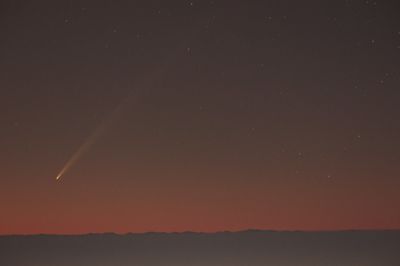


Comet C/2023 A3 (Tsuchinshan-ATLAS) is now bright and clearly visible in the sky, with its beautiful tail, and it is getting brighter. Stunning footage shows the comet rising before sunrise and moving in the direction of its tail – this made a member of our team remark that it looked like it was going “backward”, and we had to break it to them and tell them that the comet was actually moving in that direction. The tail is not always pointing away from the comet’s direction of motion.
First of all, let’s talk about the video. The comet is moving at tens of kilometers per second but you are not actually seeing the motion of the comet. You are seeing the motion of the Earth. The Earth is rotating quite fast, so objects in the east rise in a westward direction. But it does not mean that the comet is not also going that way.
Comets can have one or two tails, and they both depend on the Sun. Comets are icy and as they get close to the Sun those material sublimate – going from solid to gas – and form the coma, the fuzzy atmosphere around the comet nucleus. It is then the action of the solar wind that creates the tails. Dust and gas usually become the primary tail, the curved one, and the straighter one is the ion tail formed by glowing ionized gas.
The tails point away from the Sun – always. They are slightly different in direction because the ion tail is affected by magnetic fields, so points at the streamline of the solar wind – the plasma released constantly by the Sun. Comets go around the Sun in very eccentric orbits so as they approach the Sun, the tail is behind them, like a Hollywood silver age Diva’s scarf billowing in the wind as she drives a convertible.
But the interactions with the solar wind in space are only marginally affected by the speed you have around the Sun. The solar wind is faster, meaning as the comet moves around the Sun, the tail’s direction also changes, from being behind to going ahead of the comet.
Comet Tsuchinshan-ATLAS went through its closest passage with the Sun a few days ago, so the tail is now pointing, roughly, in the same direction as it is moving. But, powered by the solar wind, the tail is faster so it will stay ahead.