Space and Physics
 PUBLISHED
 2
2



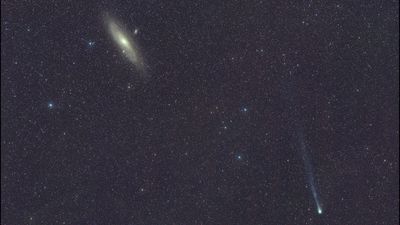


People across North America will experience a total solar eclipse on April 8. Going from the west coast of Mexico diagonally towards the east coast of Canada, the spectacle is expected to be seen by millions. And those lucky observers might see more than they were expecting. As the sky darkens during the minutes of totality, a comet may appear.
The comet in question is called 12P/Pons–Brooks, which was discovered in July 1812 by Jean-Louis Pons. It was later rediscovered in 1883 by William Robert Brooks, before realizing it was the same comet as the 1812 one. It goes around the Sun every 71 years, and this year is the year that it once again gets close to our star.
The perihelion, the closest point to the Sun in its orbit, is going to happen on April 21 so it is going to be bright – hopefully bright enough to be visible to the naked eye after sunset in those weeks, and potentially bright enough to be visible during the eclipse.
If you are among those lucky ones who are seeing the eclipse, as the Moon and the Sun meet in the sky you will have four minutes to admire the event, so you might also have a look around. The activity of the solar corona may become more obvious, especially due to the approaching solar maximum.
To the west, there will be Venus, to the east Mercury and Jupiter should be spotted by observers, and between the two planets, you should be able to see comet 12P/Pons-Brooks. The comet is currently at the very limit of visibility to the naked eye. With a few more weeks of approach to the Sun, it might have enough time to begin to show off a bit more.
The eclipse will start from Mazatlán in the Mexican state of Sinaloa, where the path of totality will be about 200 kilometers (124 miles) across, shrinking to 160 kilometers (100 miles) by the time it gets to Newfoundland. In the US alone, there are 31 million people already living in the path of totality and it will pass from Texas to New York state via Tennessee.
If you fancy seeing the eclipse and the comet, you better start planning 'cause time is running out – and please wear appropriate eyewear for it!
If you'd like to see the comet ahead of time you will still need a telescope, or you can watch it online with the Virtual Telescope team who have an observing event coming up this Sunday.