Space and Physics
 PUBLISHED
 19
19



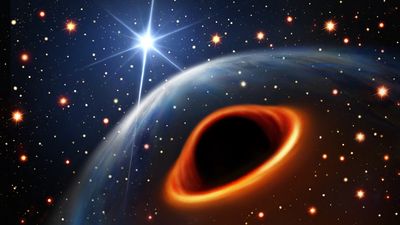


Astronomy is full of puzzling objects, and an international team of researchers has just added another juicy one: A dense compact object that has been spotted orbiting a pulsar. This in itself is not that groundbreaking – but the mass of this object is puzzling. It is in the so-called mass gap. Researchers are either observing the heaviest neutron star known or the lightest black hole.
When stars much heavier than the Sun go supernova, they can form two different types of objects. If they are not too big, they will collapse into a neutron star. Neutron stars are stellar objects made of only neutrons (the particles at the center of an atom with zero electric charge) and have an incredible density. A teaspoon of neutron star matter has a weight similar to that of a mountain.
Neutron stars can have various properties. Pulsars are a type of neutron star that spin fast around their axis, emitting periodic pulsation. Millisecond pulsars such as the object in this study (called PSR J0514−4002E) spin hundreds of times per second. They act like some of the most precise clocks in the universe.
The other dense object that a supernova can create is a black hole – an object so dense that nothing, not even light, can escape. Observations and theories put the heaviest possible neutron star at 2.2 times the mass of the Sun. The lightest black hole is expected to be around five times the mass of the Sun. In between, there’s the mass gap, where an object is expected to be a black hole unless we are missing something in the physics of neutron stars.
The companion of the pulsar in this case has a mass between 2.09 and 2.71 times that of our Sun. It could be a system with a pulsar and a black hole; or one with neutron stars, one of which is pulsating.
“Either possibility for the nature of the companion is exciting. A pulsar–black hole system will be an important target for testing theories of gravity and a heavy neutron star will provide new insights in nuclear physics at very high densities,” co-author Professor Ben Stappers, from The University of Manchester, said in a statement.
The pulsar spins (and so pulsates) 170 times every second, which has been observed with the MeerKAT radio observatory. By studying tiny variations of this rhythmic signal, researchers were able to estimate the properties of the system. The precision reached is incredible given that these two celestial bodies are 40,000 light-years away.
“Think of it like being able to drop an almost perfect stopwatch into orbit around a star almost 40,000 light years away and then being able to time those orbits with microsecond precision,” added Ewan Barr from Max Planck Institute for Radio Astronomy, who led the study with his colleague Arunima Dutta.
The team believes that the companion is not the direct consequence of a supernova, but rather that it was originally two neutron stars, merging into this massive object.
It might seem peculiar to have three neutron stars in a single system, but this object is in a globular cluster. This is a spherical collection of stars with a much higher density than other places in the galaxy, like our neighborhood. It’s common for many stars to interact in the globular clusters. Such interactions probably led to the formation of an incredible object. And while we don’t know exactly what it is yet, researchers are committed to finding out.
“We're not done with this system yet,” Arunima Dtta concluded. “Uncovering the true nature of the companion will [be] a turning point in our understanding of neutron stars, black holes, and whatever else might be lurking in the black hole mass gap.”
A paper describing this research is published in the journal Science.