Space and Physics
 PUBLISHED
 7
7



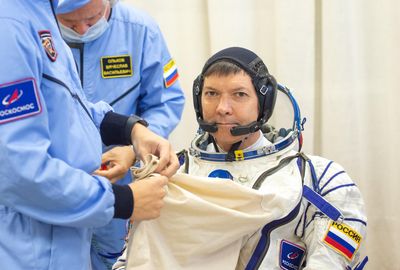


Russian cosmonaut Oleg Kononenko has just broken the world record to become the person who has spent the most time in space ever. He has now been in space for over 879 days, beating the previous record of fellow cosmonaut Gennady Padalka's 878 days, 11 hours, 29 minutes, and 48 seconds in space. Both cosmonauts achieved this cumulatively over five missions, but Kononenko’s fifth mission is not even halfway through, meaning he is set to smash the record this year.
The 59-year-old cosmonaut is scheduled on the International Space Station until September 23. He will clock in 1,110 days in space by the time he comes back to Earth, which is roughly 2.5 years. Kononenko, who is the commander of the cosmonauts corps, will cross the never-before-achieved 1,000 days in space on June 5.
"I fly into space to do my favorite thing, not to set records," Kononenko told Russian news agency TASS in an interview, reports Reuters. "I am proud of all my achievements, but I am more proud that the record for the total duration of human stay in space is still held by a Russian cosmonaut."
An achievement, yes, but microgravity is not exactly a welcoming environment for the human body so extended stays in space take their toll. What happens to your body in space is often weird and in some cases disgusting. The first thing that happens is fluids like blood move towards your head, which is annoying at first but then sort of balances in a worrying way. You also lose blood cells, a fair bit of them.
Your muscle mass also reduces as you don’t have to work too hard in microgravity, which is why astronauts spend a lot of time in the gym. The same goes for your bones, which become reabsorbed into your body. On the plus side, your feet will lose all their calluses. So you’ll be back down on Earth a bit anemic but with feet as smooth as a baby.
Russia also holds the record for the longest single stay in space. Valeri Polyakov spent 437 days and 18 hours (more than 14 months) on the Mir space station in the mid-1990s. American astronaut Peggy Whitson holds the NASA record for cumulative time with 655 days in space. Frank Rubio holds the NASA record for the longest single space flight at 371 days, which he achieved last September – despite not being planned!