Technology
 PUBLISHED
 2
2


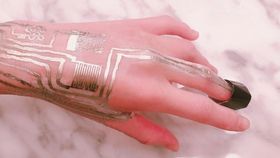


Sensors printed directly on the skin have been inching closer to commercial reality in recent years. The dream of highly sensitive sensors could have a wide array of applications, from robotics to medicine, but the field has been limited by its method of circuit printing. Currently, printing circuits directly on the skin requires a lot of heat – something the skin isn’t generally fond of.
Now, researchers believe they may have solved this problem. A team from Penn State University have developed a method of fabricating high-performance circuitry directly on skin without heat, according to a study published in ACS Applied Materials and Interfaces.
While flexible sensors already exist and have applications in future physiological monitoring, applying that technology to the skin has remained an issue for scientists. If this process is viable on a large scale, it may pave the way for the technology to help patients with various conditions.
Traditional methods of bonding the components within a sensor, called sintering, require temperatures of around 572°F (300°C), which renders the process incompatible with skin applications.
"The skin surface cannot withstand such a high temperature, obviously," Huanyu "Larry" Cheng, a Dorothy Quiggle Career Development professor in the Penn State Department, said in a statement. "To get around this limitation, we proposed a sintering aid layer – something that would not hurt the skin and could help the material sinter together at a lower temperature."
The new layer is made of calcium carbonate and an alcohol paste commonly found in peelable face masks. By applying the layer before sintering, the surface becomes smoother and the materials can bond without extreme heat. Even better, the materials used are recyclable and can be removed with just hot water.
"It could be recycled, since removal doesn't damage the device," Cheng said. "And, importantly, removal doesn't damage the skin, either. That's especially important for people with sensitive skin, like the elderly and babies. The device can be useful without being an extra burden to the person using it or to the environment."
The researchers say the sensors can monitor “temperature, humidity, blood oxygen levels and heart performance signals” and transmit them wirelessly to a network. But this may just be the tip of the iceberg. Some new devices are already in development or on the market for monitoring diabetes and neurological disorders. Wanting to swiftly make use of their discovery, Cheng now plans to use adapt the technology to monitor Covid-19 symptoms in patients.