


 Space and Physics
 PUBLISHED


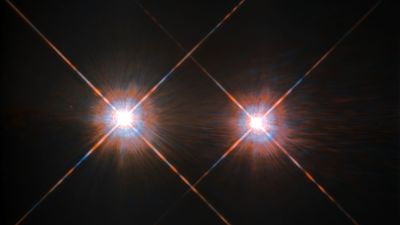


Researchers in the Department of Mechanical Engineering at Texas A&M University have demonstrated a breakthrough in light-driven motion, which could one day take us to Alpha Centauri within just a few decades, rather than thousands of years.
Space is big and human lifetimes short. If we want to one day explore solar systems other than our own, we will need to considerably up our game. Traveling at the speed of Voyager, though not our fastest spacecraft to date, it would take over 73,000 years to arrive at Alpha Centauri, the nearest star system to Earth. That's a tough ask for any astronaut, and unless you have some sort of stasis system ready to go, or a plan for how to manage a generational ship for tens of thousands of years, as well as plenty of fuel, we will need some speedier options.
One idea, which has been proposed for decades, is the idea of using light to propel light spacecraft long distances. The basic idea is to use the momentum of photons – emitted by the Sun, or powerful, human-built lasers – to accelerate a spacecraft and set it on its course. It's a lot more refined than that, but Dr Shoufeng Lan, assistant professor and director of the Lab for Advanced Nanophotonics, describes it in a statement as like bouncing ping pong balls off a surface; there will be a measurable force on the surface the balls collide with.
"From Newton’s law of motion, any momentum change between the input and output light at an interface can generate a compensating mechanical reaction force on the interface itself," the team explains in their paper, relating it specifically to ultrathin materials known as "metasurfaces" used in optics and photonics. "Despite its fundamental nature, a general relationship between anomalous deflection and the resulting optical force has been missing."
One problem, which the new study made a lot of progress on, is controlling the direction of any resulting craft, or whatever the technology becomes useful for.
"Building on generalized Snell’s law and momentum conservation, we develop a theoretical framework that connects the momentum change induced by metasurfaces with force generation," the team explains. "The generated forces are not only lateral but also vertical, enabling full three-dimensional (3D) optical control. We term these controllable forces metaphotonic forces, since they arise directly from engineered momentum transfer from the metasurface."
Demonstrating the concept, the team carefully put together micron-scale metajets made of silicon nanopillar arrays, designed to give the metajets three-dimensional maneuverability when a laser was shined upon them. On this front they were successful, showing control over the metajet in a fluid using linearly-polarized light, while no apparent unwanted rotational motion was detected in the experiments.
"More importantly, we leverage metasurfaces to a general structured interface and develop a basic model for generating metaphotonic forces with reflection and refraction by combining Newton’s law of motion and Snell’s law," the team concludes. "Meanwhile, our model shows that the metaphotonic force augments with increased optical power while having no limitations on the overall size of structured objects. Therefore, metaphotonic forces may extend optical manipulation from the predominant microscopic and sub-microscopic scales to large settings, such as interstellar light sails in space travel and exploration."
While an interesting and exciting study, don't expect these shortened missions to launch any time soon, with much more development needed. For now, the team is now hoping to conduct further tests of the concept within microgravity environments.
The study is published in Newton.


