Space and Physics
 PUBLISHED


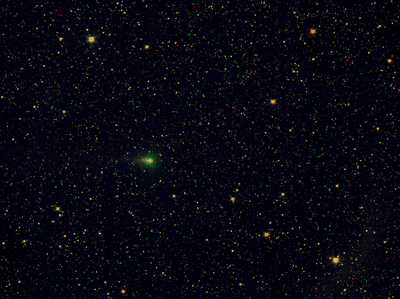


Interstellar comet 3I/ATLAS stole our hearts in 2025. Discovered on July 1, and only the third known interstellar visitor, it reached its closest distance to Earth before Christmas, and became a staple of scientific investigations and coverage from multiple missions and telescopes. It was also pretty weird and disappeared behind the Sun for several weeks. During that time, it was robotic explorers that kept an eye on it, and only in the past few weeks have we received data to analyze from these spacecraft.
Among them is the European Space Agency’s JUICE mission, which is bound for the icy moons of Jupiter. Over the last few weeks, ESA released some early images and videos, and now it has released even more, plus several insights into the properties of the comet.
JUICE studied comet 3I/ATLAS right after perihelion, its closest approach to the Sun. The comet didn’t get super-close to the Sun. At perihelion, it was 210 million kilometers (130 million miles) from our star. Still, for a comet that formed over 7 billion years ago (possibly 10-12 billion years ago) and might not have passed by a star for at least 10 million years (but maybe much longer), this was enough to dramatically affect its icy body.
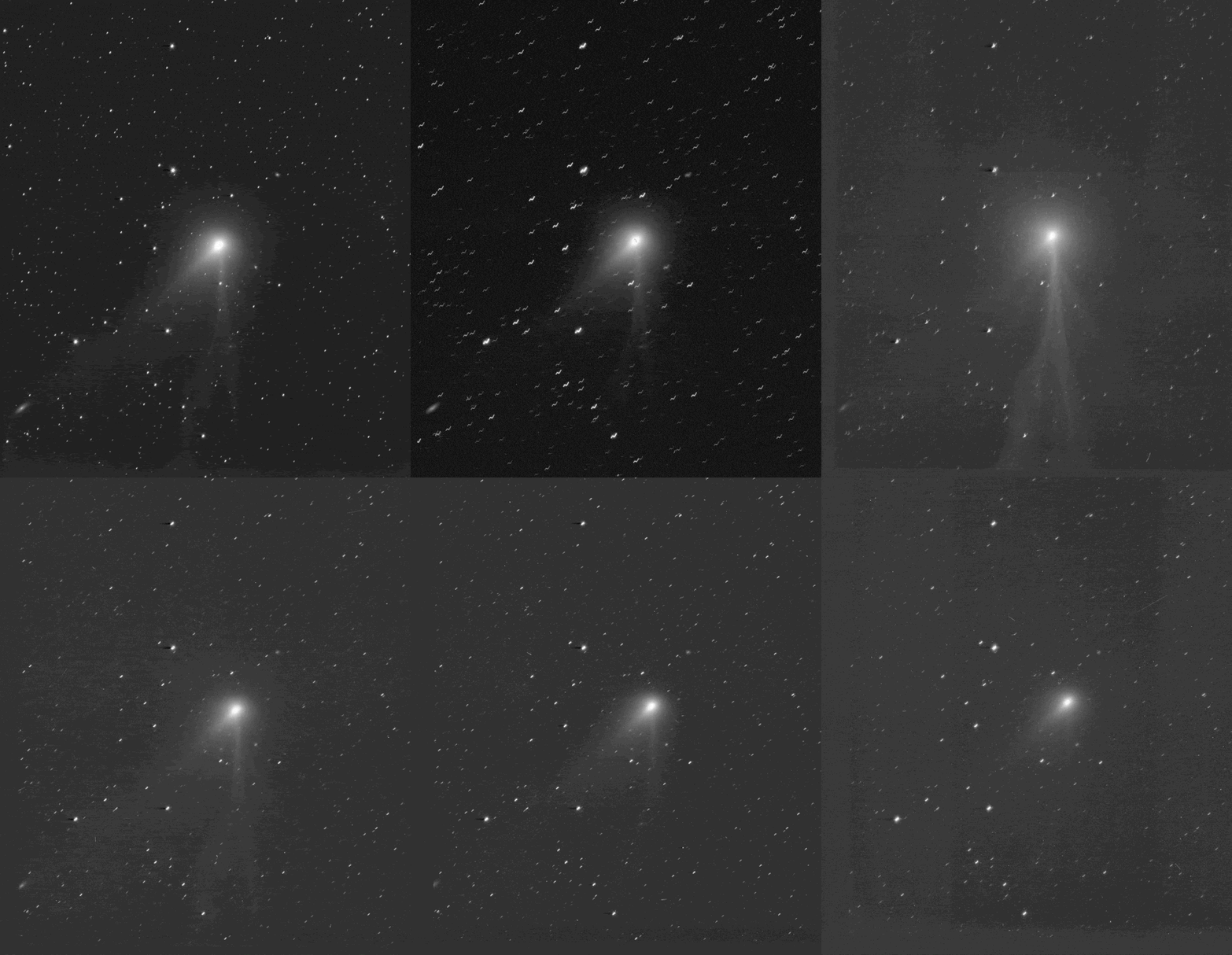
The data from the ESA spacecraft revealed that the comet was losing 70 Olympic swimming pools worth of water per day, or about 2,000 kilograms of water vapor every second. Based on data from known comets, this is on the high side, but still just one-tenth of what Halley’s Comet releases, though Halley gets much closer to the Sun.
It also seems that the emission came mostly from the Sun-facing side of the comet, the region that began, early on, sporting an anti-tail. Cometary tails point away from the Sun, but an anti-tail is possible when grains are released and sunlight and solar wind can’t push them away. This is confirmed by the fact that most of the water vapor came not from the nucleus but from grains in the coma, the halo of dust and gas.
Ultraviolet observations estimate that the comet's gas and dust elements stretched for 5 million kilometers (3.1 million miles). Again, big but not record-breaking. Some cometary tails stretch for 10 million kilometers (6.2 million miles). The conclusion so far stresses what astronomers have been saying for a while. The comet was an exceptional object from beyond the Solar System and, at the same time, a pretty regular comet.
More data continues to be analyzed, which might reveal something more peculiar, such as its chemical makeup, its level of activity moving away from the Sun, and more. JUICE was not designed for this, but it truly stepped up to the challenge.
“This campaign was unexpected for everybody! For JUICE, indeed, we are in a cruise phase during which there are thermal constraints, being relatively close to the Sun (with respect to the science phase around Jupiter),” Olivier Witasse, ESA Project Scientist, told IFLScience back in October when the campaign was announced. “Therefore, no payload activities were expected to take place at this moment. However, given the uniqueness of these observations, it was decided to prepare this extra observation planning.”
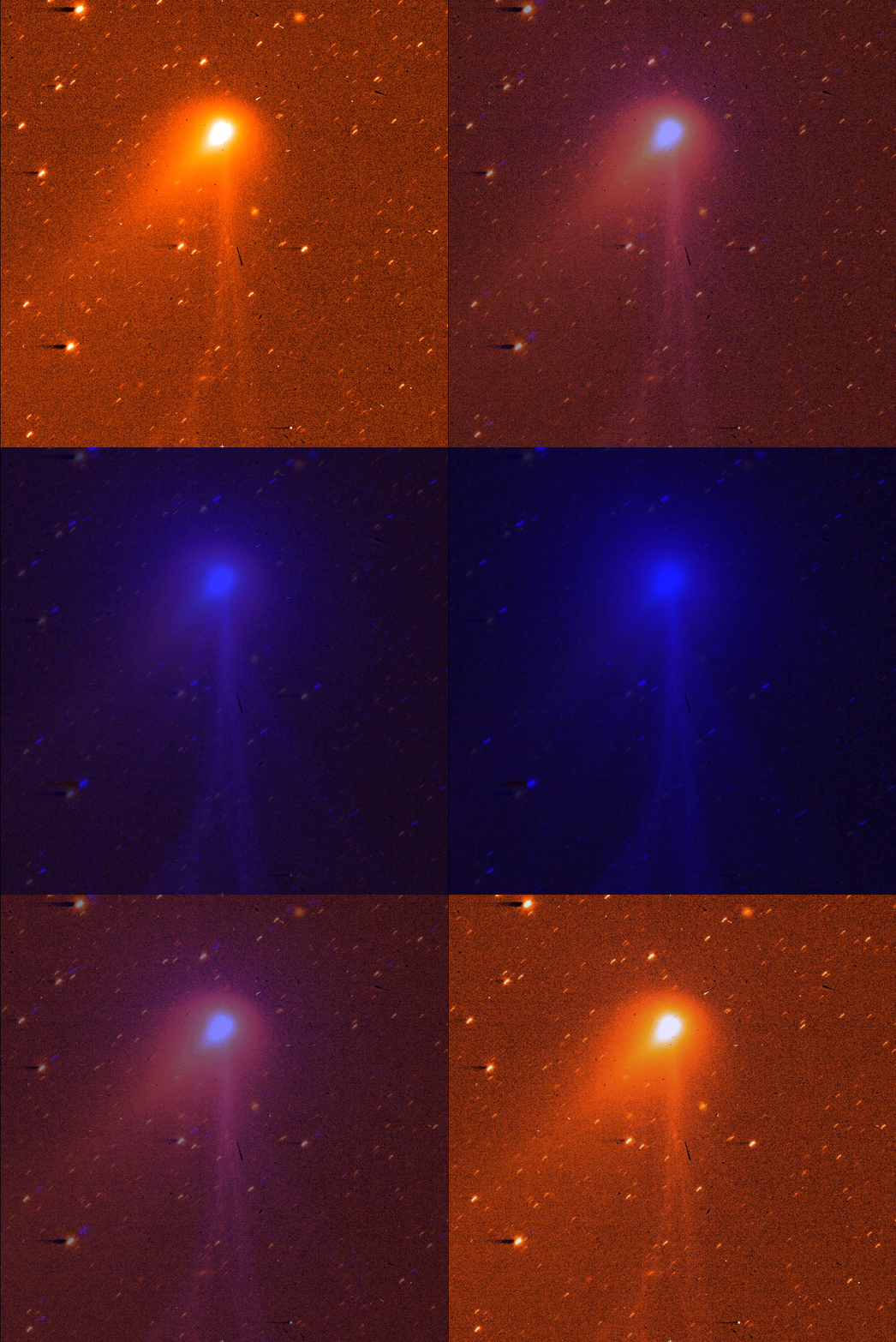
A bonus fact was that the data collected by JUICE was used to better inform the uncertainties on the comet’s orbit, showing that deep-space missions can provide important data related to planetary defense. 3I/ATLAS was in no way a dangerous object to Earth, but other asteroids that might pose a danger exist, so knowing new approaches to better constrain their orbits is important.
For JUICE, barring more interstellar visitors, the focus now is continuing towards Jupiter and its icy moons. The probe will get there in 2031. Still, this observation campaign showed what the mission is capable of.
“The data we are already seeing from Juice’s instruments is really promising,” Co-Project Scientist Claire Vallat said in a statement. “We are getting more excited about how well they work and how much we will reveal about Jupiter and its icy moons in the 2030s.”