Space and Physics
 PUBLISHED


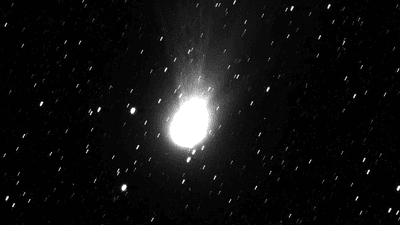


The European Space Agency (ESA) continues to deliver new insights into 3I/ATLAS, the interstellar comet that crossed the inner Solar System last year and is now past Jupiter. It was ESA’s Jupiter-bound mission JUICE that had a pretty lucky encounter with this object from beyond the stars, and the data has been slowly pouring in. The latest update is a video!
At the time of the observations, comet 3I/ATLAS had just passed its perihelion, its closest ever approach to the Sun. While still 210 million kilometers (130 million miles) from our star, this was enough to affect this icy body, which had not experienced much heat traveling between stars for billions of years.
JUICE was about 66 million kilometers (41 million miles) from the comet when the observations took place, allowing the spacecraft to be relatively close to the comet. 3I/ATLAS itself was discovered in July 2025, and from the get-go, astronomers around the world started working out when and from where to best observe it. That eventually included data from Mars and from several deep space missions, including fellow Jupiter-bound mission Europa Clipper.
“Almost since the time of discovery, we realised that the geometry of the orbit would allow observations from the Juice spacecraft, which would observe the comet from a completely different angle than what we can do from Earth,” Marco Fenucci, Mathematician and Near-Earth Objects Dynamicist at ESA’s Near-Earth Object Coordination Centre (NEOCC), said in a statement.
JUICE retained a crucial advantage to be able to study it after its peak in activity. Months of lead-up might seem like a long time, but that's not the case for a spacecraft that is not doing any science, since it’s still traveling to its target.
“Preparations for things like payload pointing campaigns or flybys are usually in the order of nine months,” explained JUICE Spacecraft Operations Manager Angela Dietz. “When ATLAS came, we knew there was not a lot of time.”
“This campaign was unexpected for everybody! For JUICE, indeed, we are in a cruise phase during which there are thermal constraints, being relatively close to the Sun (with respect to the science phase around Jupiter)," Olivier Witasse, ESA Project Scientist, told IFLScience back in October when the campaign was announced. "Therefore, no payload activities were expected to take place at this moment. However, given the uniqueness of these observations, it was decided to prepare this extra observation planning.”
The data from JUICE continues to come. The spacecraft was on the other side of the Sun for a while, so the data transmission was limited. Now, we are really getting the juicy bits. The video is made from 53 photographs of 3I/ATLAS from the spacecraft's Navigation Camera (NavCam).