Space and Physics
 PUBLISHED



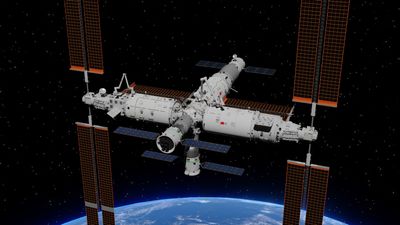


Chinese scientists report the discovery of a new strain of bacteria that exists only inside the Tiangong Space Station. The new microbe has been called Niallia Tiangongensis; it is related to the human pathogen Niallia circulans, which is linked to wound infections, and is usually soil-dwelling. Well, from humble beginnings to the stars.
The Chinese space agency began the construction of the Tiangong Space Station in 2021, with the launch of its core module. Three taikonauts are sent there every four months to conduct experiments in orbit, including the collection of samples from surface hardware inside the space station, which has revealed the new bacteria.
The presence of mutated bacteria is not that unexpected, however. Something similar has been seen on the International Space Station. Back in 2018, five strains related to opportunistic pathogen Enterobacter bugandensis were discovered, and then last year, eight more were seen, and they look to be genetically distinct from their Earthly counterparts.
In May 2023, taikonauts Fei Junlong, Deng Qingming, and Zhang Lu collected swabs from a cabin as part of CHAMP, the CSS Habitation Area Microbiome Programme (CSS stands for China Space Station… yes, it’s acronyms all the way down in science). The new results are part of CHAMP.
It is unclear at this point if Niallia Tiangongensis evolved in space from the N. circulans version through specific mutations or if some spores with advantageous genetic changes found themselves in an environment where those mutations could give them an advantage. For example, the new species can break down gelatin, using it as a source of both nitrogen and carbon.
Some protein mutations also seem to indicate a possible enhancement in the ability to create biofilms, which connect and protect different individual microorganisms. Some also have a better response to oxidative stress and can more easily repair themselves from radiation damage. All of these would come very handy in space to fight against microgravity and enhanced radiation levels.
Studying how bacteria evolve in space is very important for the health of astronauts, cosmonauts, and taikonauts of the future. In fact, despite mutations, the space environments we currently have might be too clean for human health. This work is also applicable to life on Earth; these mutations might reveal some weak spots of these pathogens that could be used to fight them off here on Earth.
The study is published in the International Journal of Systematic and Evolutionary Microbiology.