Nature
 PUBLISHED
 14
14


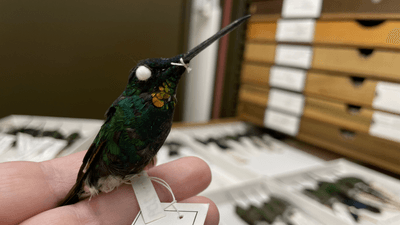


A peculiar hummingbird that was thought to have been a new species has been found to actually be a rare hybrid never-before-reported in science. The bird stood out to researchers because it has a gold throat, a trait that became particularly peculiar when DNA revealed that both of its parents had pink throats.
The bizarre bird first came flittering into the view of senior author on a new study John Bates while doing fieldwork in Peru’s Cordillera Azul National Park, which sits on an outer ridge of the Andes. Because its an isolated habitat, it figured that a strange-looking animal might well be a genetically distinct population, making it a new species, which is why that was Bates’ first assumption.
“I looked at the bird and said to myself, ‘This thing doesn’t look like anything else,’” he said in a statement. “My first thought was, it was a new species.”
They continued their investigations into the unusual bird at the Field Museum’s Pritzker DNA Lab, running sequences that include genetic material from both parents and looking for mitochondrial DNA, which usually only gets passed on by the mother (but not always). What they saw came as a big surprise.
“We thought it would be genetically distinct, but it matched Heliodoxa branickii in some markers, one of the pink-throated hummingbirds from that general area of Peru,” explained Bates.

The samples also matched another pink-throated hummingbird, Heliodoxa gularis, however it wasn’t a 50/50 split. What appears to have occurred is that some time in the bird’s ancestral past an H. branickii mated with an H. gularis to make a half-and-half hybrid that then went on to have subsequent generations with H. branickii only.
This more complex recipe for a hummingbird explains the curious appearance of a gold throat in a long line of pink throats. While both mum and dad would’ve had pink throats, the mixture of pigments they put into creating that magenta color would’ve been slightly different, and when these subtle differences combine in a hybrid offspring it can result in further small changes that amount to a big difference in overall coloration.
“It’s a little like cooking: if you mix salt and water, you kind of know what you're gonna get, but mixing two complex recipes together might give more unpredictable results,” said the study’s first author, Field Museum senior research scientist Chad Eliason. “This hybrid is a mix of two complex recipes for a feather from its two parent species.”
Hybrids like this one could be a contributor to the incredible range of colors seen among hummingbirds, as the researchers predict that such a drastic color change would typically take around six to 10 million years to come about in a single species. While it used to be thought that offspring of separate species would be sterile, animals like this gold-throated bird prove that isn’t always true and that they may be responsible for rapid changes in animal phenotypes out in the wild.
The study was published in Royal Society Open Science.