Space and Physics
 PUBLISHED




The Earth is an oblate spheroid, as has been apparent since the time of Eratosthenes and before. If you want to know that the Earth is round for yourself, you don't need to "sail to the edge" – you can even test it with a security camera and a garage.
But still there are some stragglers out there who still want to believe in pancake Earth. In a new episode of StarTalk, Neil deGrasse Tyson has taken one further attempt to patiently explain why the Earth could never be flat, given what we see around us.
DeGrasse Tyson, American astrophysicist and science communicator, discussed a particularly stupid version of the flat-Earth hypothesis.
"What's odd is there are people who think Earth is flat, but recognize that the Moon is round, Mercury, Venus, Mars, Jupiter, Saturn, Uranus, Neptune, and the Sun are all spheres, but the Earth is flat," the 67-year-old said, summarizing the "only the Earth is a pancake" scenario.
While this would have the benefit of replicating a little of what we see in the sky (guess what, those objects are spheroids rather than like giant spinning pennies), this model falls pretty quickly if you try and recreate anything approaching the normal orbits of the planets. But you can disprove this one for yourself without even fetching a stick, if you have ever seen a lunar eclipse.
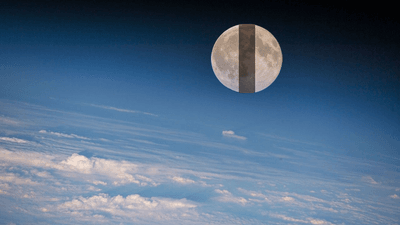
"The Sun is always casting Earth's shadow into space, it's always there no matter what" deGrasse Tyson explains in the video. "The Moon occasionally passes through that shadow. And if you see the shape of Earth's shadow on the Moon, it is always round."
And that's all you really need to dispel the "only Earth is a pancake" scenario.
"If Earth were flat, sometimes you would get a flat shadow, and we've never seen a flat shadow," he explained, adding that the only shape of object which produces these round shadows are, you guessed it, a sphere. Meanwhile, a disk would produce circular shadows some of the time, and a lot of giveaway, non-circular shadows the rest of the time. This particularly odd version of the flat-Earth "idea" is ruled out by the existence of lunar eclipses.
Tyson goes on to explain the story of how Eratosthenes, believing the Earth to be a sphere, measured the circumference of the Earth using shadows, a stick, and a deep well in Syene, Egypt, known better today as Aswan, way back in 240 BCE.
"People walked down circular steps to get into the well to get water. It was very dark on the steps when people were walking down. But on one day a year (June 21st), the sunlight at noon shone all the way down to the bottom of the well. He noticed that his own shadow was very 'short' on that day, only covering his feet but not the ground nearby," NASA explains of the ancient scholar.
"Eratosthenes went to another city in Egypt – Alexandria. On that same day of the year, sunlight did not reach the bottom of wells. And he noticed that his shadow was 'longer'."
Eratosthenes measured the shadow cast by a rod in Alexandria, and found that it was 7° 12' from perpendicular, rather than fully perpendicular to the Sun, as was seen in Aswan.
"The Sun is so far away that its rays are parallel when they reach the Earth. Sticks at different angles to the Sun's rays will cast shadows of different lengths. For the observed difference in the shadow lengths, the distance between Alexandria and Syene had to be about seven degrees along the surface of the Earth; by that I mean, if you imagine these sticks extending all the way down to the center of the Earth, they would there intersect at an angle of about seven degrees," American astronomer Carl Sagan explained in the television series Cosmos. "Seven degrees is something like one-fiftieth of the full circumference of the Earth, the 360 degrees."
Knowing the distance between Alexandria and Syene was around 5,000 stadia, having hired a team of walkers to measure it, and that the angle was around 1/50th of a circumference, he figured out the circumference of the Earth must be 50 x 5,000, or 250,000 stadia. Though there were some complications, including that Alexandria and Syene are not on the same meridian as he had assumed, this was accurate to within 1.4 percent of the real circumference of Earth.
If Eratosthenes could do that in 240 BCE, surely you can accept that the Earth is not the only pancake floating its way through space in 2026 CE.