Technology
 PUBLISHED


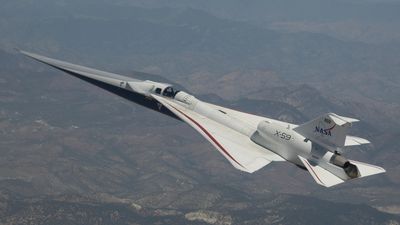


NASA is about to start testing its latest supersonic jet in the coming weeks, but this is not like any other supersonic jet. It can break the sound barrier without the typical bang.
The jet is known as X-59 and has already flown 14 times since its inaugural flight last October. Tests carried out so far were to attest to the general engineering of the plane. Now, it will actually demonstrate what it has been designed for: quiet supersonic flying.
The demonstrations, starting in early June, will see the X-59 fly at over 1,014 kilometers (630 miles) per hour at an altitude of around 13,106 meters (43,000 feet). This is going to be both a major milestone and a crucial test for the vehicle.
“What comes next is the first time this one-of-a-kind aircraft will fly supersonic,” Cathy Bahm, project manager for NASA’s Low Boom Flight Demonstrator, said in a statement. “We are starting toward the mission conditions test point that X-59 was designed for.”
What is a sonic boom, and how is it created?
A sonic boom is a thunderclap-like sound released by an object moving through air (in this case) faster than the speed of sound. It’s a big release of sound energy, and for this reason, it is loud.
Supersonic planes are few and far between, and they do not usually travel over inhabited zones, but you still might have heard of a sonic boom. The typical crack of a bullwhip is an example of a sonic boom; the tip can move faster than sound. The crack is only a tiny sonic boom, however; the tip of the whip just hasn’t got the same momentum as a jet.
At a more detailed physics level, we are looking at pressure waves. An object moving through a fluid creates pressure waves in front and behind. These waves move through the fluid at the speed of sound in that medium.
When an aircraft (or the tip of a whip) moves closer and closer to the speed of sound, the waves in front become squished together. When it passes the speed of sound, they merge into a single shockwave and go boom.
How does the X-59 avoid a sonic boom?
A vehicle moving at a speed higher than the speed of sound will constantly create sonic booms. For the people on board, this is a fast way to travel, but the people under the plane’s path might find the constant thunderclap very annoying.
This is why X-59 is an important test, as it might lead to supersonic commercial vehicles that could fly anywhere. To avoid the sonic boom, X-59 needs to be capable of breaking those pressure waves. The secret to doing so is in its thin, tapered nose, which takes up one-third of the vehicle’s 30.3-meter (99.7-foot) length.
X-59 is an experimental plane, and hopefully it will demonstrate its ability to fly quietly shortly. It is not the blueprint for a commercial vehicle, however. It wouldn’t be a case of simply adding seats.
Still, the test can be considered fundamental when looking at how supersonic flight has developed historically. For example, the Bell X-1 rocket engine-powered aircraft later informed the development of the Concorde.
“As we look ahead to the upcoming flights, we’re poised to open the envelope even further – moving boldly toward the mission test point this aircraft was built to achieve,” Bahm added. “Flying supersonic and reaching these milestones isn’t just progress; it’s the realization of years of perseverance, innovation, and teamwork. Each step brings us closer to Phase 2, and to the future of commercial supersonic flight.”