Space and Physics
 PUBLISHED


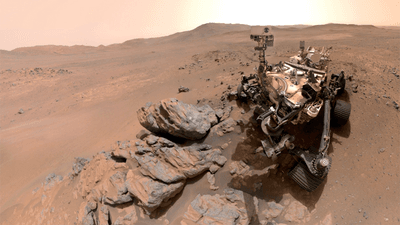


NASA's Perseverance rover has left the Jezero Crater on Mars, pausing for a selfie in the Martian "Wild West" whilst analyzing some of the oldest rocks on the Red Planet.
The Perseverance mission has, thus far, been a successful one for US space agency NASA. Though the question of how the samples will be returned remains open, with the Mars Sample Return mission being killed off earlier this year, the rover has been diligently collecting the most interesting rocks, abrading them for analysis, and storing them inside sample tubes ready for collection.
The rover first landed in the Jezero Crater on February 18, 2021, with an exciting mission ahead of it.
"We picked Jezero Crater as a landing site because orbital imagery showed a delta – clear evidence that a large lake once filled the crater. A lake is a potentially habitable environment, and delta rocks are a great environment for entombing signs of ancient life as fossils in the geologic record," Perseverance’s project scientist, Ken Farley of Caltech, explained in a 2023 statement. "After thorough exploration, we’ve pieced together the crater’s geologic history, charting its lake and river phase from beginning to end."
During this phase of the mission, the rover found evidence that the crater was in fact once host to an ancient Martian lake, some 3.6 billion years in the planet's past. More excitingly, in a rock nicknamed Cheyava Falls, it found possible biosignatures. It is far from confirmed, but it is possible that the rover has already found signs of life on Mars.
That's enough work for any rover, but it is not done yet. Perseverance has ascended to the top of the Jezero Crater, climbing an impressive 500 vertical meters (1,640 vertical feet) over the course of around three and a half months. Now in an area nicknamed "Lac de Charmes" (Lake of Charmes), the rover can help us learn a lot more about how the area formed.
"This area just beyond Jezero’s rim will be the prime place to search for pre-Jezero ancient bedrock and Jezero impactites – rocks produced or affected by the impact event that created Jezero crater," NASA explains.
But you can't go to Mars without taking a few selfies. At this new vantage point, the rover paused other activities to capture itself in front of an alien backdrop.
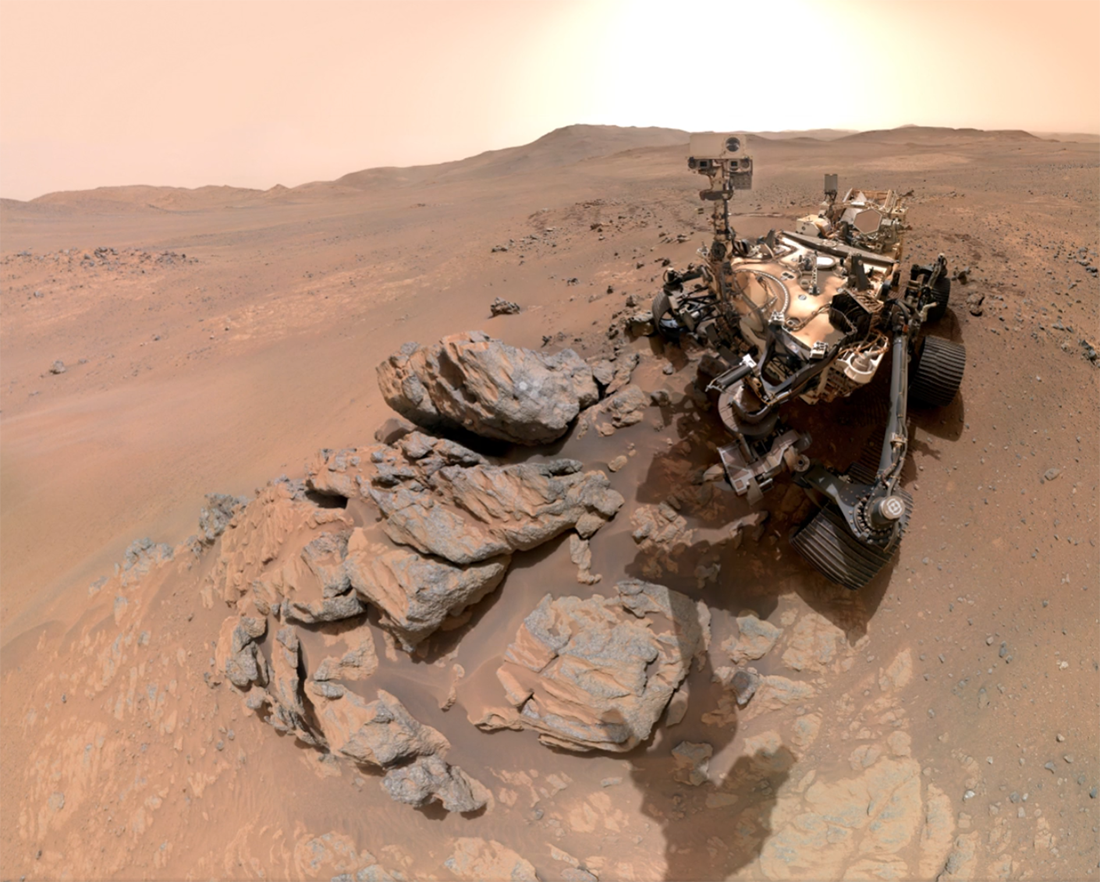
Before you start constructing your own conspiracy theories, perhaps involving a photographer on Mars, we should point out how these selfies are obtained. Though not visible in the final result, the rover took images using the WATSON camera at the end of its robotic arm, designed not for selfies but for taking closeup images of interesting rocks for analysis back on Earth. Even with the arm extended to its maximum reach, it still required 61 images to get a full view of the rover and its backdrop, before stitching them together into one picture.
"In order to keep the camera at the same position and take the different image frames, [the arm has] to move quite a lot. It can take up to an hour of arm motion and imaging to take that entire selfie," Vandi Verma, Perseverance’s chief engineer for robotic operations at NASA’s Jet Propulsion Laboratory in Southern California, explained in a video following a 2021 selfie. "The reason you don't see the robotic arm in the selfie is because it's moving between the different image frames that we are taking, and we include enough overlap between the images so that when we stitch them together we don't have to include the arm."
As well as a selfie, the rover captured a panorama, giving a little taster of the interesting area the rover will now explore.
"We took this image when the rover was in the ‘Wild West’ beyond the Jezero Crater rim – the farthest west we have been since we landed at Jezero a little over five years ago," Katie Stack Morgan, Perseverance’s project scientist at NASA’s Jet Propulsion Laboratory in Southern California, explained in a statement. "We had just abraded and analyzed the ‘Arathusa’ outcrop, and the rover was sitting in a spot that provided a great view of both the Jezero Rim and the local terrain outside of the crater."

"What I see in this image is excellent exposure of likely the oldest rocks we are going to investigate during this mission," Ken Farley, Perseverance’s deputy project scientist at Caltech in Pasadena, added. "There is a sharp ridgeline visible in the mosaic whose jagged, angular texture contrasts starkly with the rounded boulders in the foreground. We also see a feature that may be a volcanic dike, a vertical intrusion of magma that hardened in place and was left standing as the softer surrounding material eroded away over billions of years."
Going forward, the team hopes to investigate "Gardevarri"; an area where olivine-bearing rocks, formed in cooling magma, have been spotted.
"The rover’s study of these really ancient rocks is a whole new ballgame," Stack Morgan added. "These rocks – especially if they’re from deep in the crust – could give us insights applicable to the entire planet, like whether there was a magma ocean on Mars and what initial conditions eventually made it a habitable planet."