Space and Physics




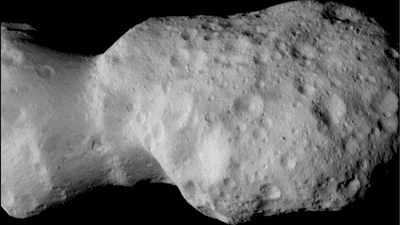


At 8 kilometers (5.0 miles) long and 3.5 kilometers (2.2 miles) wide, asteroid 52246 Donaldjohanson or simply DJ, might not seem like the most incredible space rock in the Solar System. Yet a visit from NASA’s Lucy spacecraft has now revealed some exciting insights into its past, as well as that of 2,000 other asteroids.
Over the course of 12 years, Lucy is set to visit eight asteroids, maybe more if others end up having moons, like its first target Dinkinesh. Asteroid Donaldjohanson was the second target, visited by Lucy in April 2025.
The asteroid is believed to have formed about 150 million years ago in a catastrophic collision. That impact marked the creation of about 2,000 space rocks in the inner asteroid belt, called the Erigone family after asteroid 163 Erigone, one of its members.
“The flyby of DJ allowed us to achieve a detailed understanding of its formation and evolution, also thanks to the fortuitous fact that DJ belongs to a young asteroid family,” Simone Marchi at the Southwest Research Institute, Boulder, Colorado, told IFLScience.
“Thanks to Lucy's data, we learned about DJ's formation and evolution. We constrained several physical processes that contributed to DJ's present properties, such as accretion of the two lobes, slowdown of the rotation, tumbling, ancient presence of water, cratering, and likely surface ages.”
Lucy's next ports of call are six of the Trojan asteroids that share Jupiter's orbit around the Sun, which are “fossils” of planet formation. For this reason, the mission is named after the Australopithecus fossil Lucy, a highly complete fossil of one of our prehistoric relatives that lived around 3 million years ago.
The asteroid is named after Lucy’s discoverer, US palaeoanthropologist Donald Johanson. The first asteroid the craft flew by, Dinkinesh, bears Lucy's name in the Ethiopian language Amharic.
"[S]he's become sort of the benchmark... I think that even more than [being just a skeleton], people recognize this discovery as an individual," Donald Johanson, the discoverer of Lucy, told IFLScience in November 2024, the 50th anniversary of the discovery.
Images from the flyby posted in 2025 showed that asteroid Donaldjohanson is made of two cratered lobes connected by a smooth neck. Planetary scientists count craters to estimate the age of planetary bodies, and based on the craters observed here, the asteroid is about 155 million years old. Surprisingly, though, Donaldjohanson appears to lack craters smaller than 400 meters (1,310 feet).
“The lack of craters less than 400 meters indicates that the observed surface is affected by movement of loose material that can erase surface features and cause the remarkably smooth appearance of the neck region," said Marchi. "It also tells us that these processes are occurring at a relatively fast pace, tens of millions of years at most.”
This shaky, changing little rock also holds the key to something even more exciting. Insights into the parent body that birthed the Erigone family. There is evidence in surface minerals, such as the presence of iron-bearing phyllosilicates, that indicate this bygone space rock had liquid water.
“DJ's composition informs us that water was present at some early stage, possibly shortly after the formation of the Erigone parent body at the dawn of the solar system,” Marchi explained. “However, the chemical alteration due to the presence of liquid water was limited, unlike other primitive asteroids studied in the past, such as Bennu and Ryugu.”
A paper discussing these findings is published in the journal Science.