Space and Physics
 PUBLISHED
 2
2



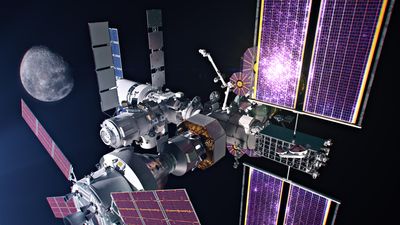


By the end of the decade, there will be another station in orbit: the Gateway. But it won’t be in low-Earth orbit like the International Space Station (ISS) or Tiangong. It will be in orbit around the Moon, making it the first outpost for humanity in deep space.
NASA has provided a gorgeous visualization to show it off. The Gateway is an international collaboration between NASA, the European Space Agency (ESA), the Japan Aerospace Exploration Agency (JAXA), the Canadian Space Agency (CSA), and the Emirates’ Mohammed Bin Rashid Space Centre (MBRSC). Construction on this is expected to begin next year with the launch of the Habitation and Logistics Outpost (HALO) and the Power and Propulsion Element.
The propulsion will make the Gateway the most powerful solar electric spacecraft ever flown. The power is needed to keep the station in the particular “near-rectilinear halo orbit” or NRHO, which is roughly perpendicular to the orbital plane of the Moon.
It will send the Gateway in a 7-day elongated path around the Moon, getting it as close as 3,000 kilometers (1,865 miles) from the Lunar South Pole and as far as 70,000 kilometers (43,500 miles) from the North Pole. Astronauts will always have contact with Earth, not needing to disappear around the Moon.
Plus, it doesn’t take too much energy to enter it from Earth or go up and down from the surface of the Moon. The vehicles that will do that are visible in the visualization. There is the Orion Capsule which will take Artemis astronauts from Earth on NASA’s Space Launch System, as well as the stand-in for the Human Landing System which in turn will be either SpaceX’s Starship or Blue Origin’s Blue Moon.

Delays in Starship testing might delay Artemis III as the first crew to land on the Moon in decades. It is scheduled for September 2026, but recent analysis from the Government Accountability Office might suggest that the mission might be delayed until 2028. This might shift some of the key milestones for the Gateway's construction.
Artemis IV is going to carry the Lunar I-Hab, an ESA structure with contribution from JAXA. The plan was to get this to the Gateway in 2028. It would then be followed by other modules in the following Artemis missions ending the first phase of construction in 2031.
The Gateway won’t be permanently inhabited like the ISS, but it will see crew spending time there as they plan and return missions to the surface of the Moon, as well as conducting certain scientific experiments farther away from the planet than ever before.