Space and Physics
 PUBLISHED
 4
4


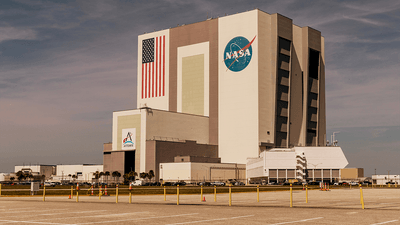


NASA has responded to President Donald Trump's latest talk of unidentified flying objects (UFOs) and unidentified aerial phenomena (UAPs).
UFO enthusiasts have waited decades for presidents of the USA to begin talking about aliens. On that front, February 2026 has probably been a real treat, with two US presidents suddenly discussing the topic. Beginning the extraterrestrial talk was President Barack Obama, who was asked, "Are aliens real?" on journalist Brian Tyler Cohen's podcast during a speed questions section of the show.
"They’re real, but I haven’t seen them, and they’re not being kept in [Area 51]," Obama told Cohen. "There’s no underground facility. Unless there’s this enormous conspiracy, and they hid it from the president of the United States."
Obama went on to clarify on Instagram that he was not talking about life visiting Earth, but life generally out there, minding its own business in the vast cosmos.
“I was trying to stick with the spirit of the speed round, but since it’s gotten attention, let me clarify. Statistically, the universe is so vast that the odds are good there’s life out there. But the distances between solar systems are so great that the chances we’ve been visited by aliens is low, and I saw no evidence during my presidency that extraterrestrials have made contact with us. Really!”
But before Obama had made these clarifying remarks, President Trump had already reacted, telling journalists on a flight to Georgia that the 44th president had "made a big mistake", essentially accusing him of revealing state secrets.
"He took it out of classified information," Trump told reporters, per Reuters. "He's not supposed to be doing that."
While it is unlikely that Obama accidentally revealed the secret existence of alien life on Earth during a speed round section of a podcast interview, Trump has since said he will direct government agencies to release more information pertaining to these phenomena.
"Based on the tremendous interest shown, I will be directing the Secretary of War, and other relevant Departments and Agencies, to begin the process of identifying and releasing Government files related to alien and extraterrestrial life, unidentified aerial phenomena (UAP), and unidentified flying objects (UFOs), and any and all other information connected to these highly complex, but extremely interesting and important, matters," Trump wrote on Truth Social, adding an obligatory, "GOD BLESS AMERICA!".
It should be noted that in recent years, the US government has been attempting to be more transparent on the topic, holding public hearings in Congress discussing UAP and UFO sightings. In these hearings, witnesses and other officials have discussed what they have seen and what investigations have concluded about the phenomenon.
Sometimes, the incidents have had definitive explanations, including an old classic: weather balloons. Others are more open-ended and require further investigation, if that is possible given the footage and witness reports available. But the wheels are already in motion, with various US agencies disclosing what they have investigated and the outcome. Responding to Trump's post, NASA Press Secretary Bethany Stevens explained that they would continue to be transparent on all topics.
"We continue to embrace President Trump’s open science commitment as an agency. We have fostered open science since our inception so that the public can build upon our innovations. We continue to make all NASA data publicly available, and welcome public participation using our data," Stevens wrote on X.
"As [NASA Administrator Jared Isaacman] has said, there are certainly things he’s come across in the job that he can’t explain… but they relate more to unnecessarily costly programs than they do to extraterrestrial life!"
Though reassuring, we should point out that Stevens' post wasn't quite accurate either. NASA continues to be one of the most transparent agencies out there, and does release most data to the public, but it does not release all of it.
"Examples of information not releasable [...] include, without limitation, information that is, or is marked as, classified information, procurement sensitive information, information subject to the Privacy Act, other sensitive but unclassified information, and information subject to privilege, such as pre-decisional information or attorney-client communications," NASA explains of its policy of releasing data to the public.
Perhaps NASA has classified secrets squirreled away – for example, the locations of military bases seen with its network of satellites – but don't expect a sudden new release explaining that aliens are real and that they have been hiding from us.