Ad

space-iconSpace and Physicsspace-iconAstronomy
clock-iconPUBLISHEDMay 17, 2024
share71

NASA Probe Snaps Photo Of Reddest Object In The Solar System

The tiny Jupiter moon can be seen in new photos from the Juno mission.

Dr. Alfredo Carpineti headshot

Dr. Alfredo Carpineti

Alfredo has a PhD in Astrophysics and a Master's in Quantum Fields and Fundamental Forces from Imperial College London.

Space & Physics Editor

Alfredo has a PhD in Astrophysics and a Master's in Quantum Fields and Fundamental Forces from Imperial College London.View full profile

Alfredo has a PhD in Astrophysics and a Master's in Quantum Fields and Fundamental Forces from Imperial College London.

View full profile
EditedbyLaura Simmons
Laura Simmons headshot

Laura Simmons

Health & Medicine Editor

Laura holds a Master's in Experimental Neuroscience and a Bachelor's in Biology from Imperial College London. Her areas of expertise include health, medicine, psychology, and neuroscience.

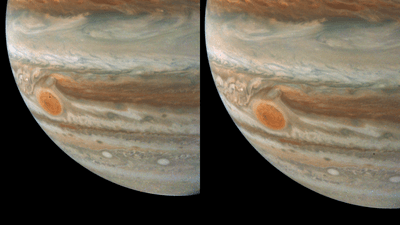
Two images of jupiter. There is a small dot on both. That is amalthea

Amalthea is just a small dot compared to Jupiter's massive size – see over the Great Red Spot on the left, and under a dark band in the Southern Hemisphere on the right. 

Image credit: NASA/JPL-Caltech/SwRI/MSSS; image processing by Gerald Eichstädt


In early March, during its close flyby of Jupiter, Juno snapped a beautiful view of the planet. And among the stunning cloud formations, there is a dark spot. In one photo, it is over a dark band. In another, it is starkly clear over the Great Red Spot. A fitting place, given that Amalthea is the reddest object in the Solar System.

Amalthea is a tiny moon of Jupiter, the third closest moon to the planet and thus the third fastest moon in the Solar System. It is just 168 kilometers across (104 miles), too small to become a sphere, so it looks like a potato. A particularly red potato. It is unclear why it is so red. It could be sulfur from Io, the volcanic moon of Jupiter, that has caused Amalthea to obtain a crimson hue, or it might be some other material from the moon itself.

A potato shaped object very red
Amalthea as seen in color by Voyager 1. Very red.
Image credit: NASA

It is also a fairly hot object. It releases more heat than it gets from the Sun, and Jupiter might be to blame for that. The planet has a formidable magnetic field and that might be inducing electric currents within the moon. Alternatively, Amalthea might experience significant tidal forces heating it up, the same phenomenon that keeps Io volcanically active.

The images were processed and enhanced by citizen scientist Gerald Eichstädt. Juno was 265,000 kilometers (165,000 miles) above Jupiter’s cloud tops when the images were taken.

Add us as a Google preferred source to see more of our
trusted coverage in Search