Space and Physics
 PUBLISHED


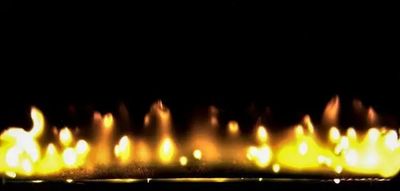


NASA is planning a pretty neat experiment for later this year, setting deliberate fires whilst on the surface of the Moon, the first time such experiments have been conducted on another celestial body.
So, what's the point of this then? Isn't fire something you'd generally like to avoid on space missions? Well, yes. This new mission isn't the result of some guy at NASA who always brings a lighter to meetings and occasionally mutters something about "feeding you the Moon". NASA takes fire safety very seriously, screening all materials for flammability prior to flights.
But there is an interesting problem: all these tests take place within Earth's gravitational field, and theoretical work shows that flammability may vary depending on the gravitational environment. Meanwhile, tests conducted in microgravity suggest that materials might not be their most flammable at 1g.
"Consider a material that is marginally nonflammable on Earth. The same material may be flammable at a lower gravity level (for example, on the Moon) since the crucial mechanism of buoyant oxygen entrainment at the flame base is still present, but at a slower rate, allowing the chemical reaction rates to 'keep up' and the flame to adequately heat the incoming cool air," NASA explains in a new paper.
"Alternatively, a material that is not flammable on Earth can be burned in microgravity, but with the introduction of a low speed forced flow of air. Applying a flow below the buoyant blowoff limit speed permits a material to burn in microgravity, albeit with a smaller flame size, even though it may not burn at all in 1-g."
Not all of these experiments are conducted on the space stations orbiting Earth, it's worth pointing out. As well as the infamous vomit comet, you can get a microgravity environment using drop towers; all you really need is the experiment to be in freefall. Of course, fire in space is a full "Houston, we have a problem" situation. Hence NASA would like to know what materials, usually reliable on Earth, might start becoming flammable little nuisances when taken on a nice trip to the Moon.
Microgravity environments aren't too tricky to produce (dropping stuff), at least conceptually. But partial-gravity environments are more tricky, involving dropping and spinning stuff at the same time. In a neat experiment referenced in the report, one team produced a partial-gravity environment of anything from 0-1.5g by dropping a centrifuge from a tower. Dropping the experiment produces a microgravity environment, whilst the centrifuge produces artificial gravity, which can be strengthened by spinning it faster.
While those experiments are pretty cool and a neat bit of thinking, they aren't ideal. They, and experiments conducted on planes, are too short to see how the flames develop. As well as this, experiments performed with a centrifuge on board the International Space Station have too small of a radius of rotation, meaning that there is an appreciable Coriolis effect, making interpreting the experiments much more complex and uncertain.
What is ideal for testing how flammable materials are on the Moon is to take materials to the Moon and then burn them, and that is what NASA is planning with the Flammability of Materials on the Moon (FM2) experiment.
The experiment, which the report lists as being planned for late 2026, will see four solid fuel samples burned in lunar gravity, while cameras record the flames as they spread. This isn't a case of just testing every material at a time to see if they become flammable on the Moon – the work should test models of flammability in lower gravity environments and allow for precise predictions that certain materials will become more flammable in reduced gravity environments.
Fire has actually been a serious problem in space several times, with the most notable being onboard Mir when a fire erupted in an oxygen generating system in February 1997, filling the space station with smoke and cutting off access to the Soyuz escape vehicles.
“The fire was so enormous and the smoke and vapour coming off this fire site was such that we couldn’t see at arm’s length," European Space Agency (ESA) astronaut Reinhold Ewald said of the incident, "and I could not at that time have imagined that we go on with the mission."
The crew were able to extinguish the fire before any major damage occurred, but it looked pretty hairy at the time. Experiments like this, the first of its kind conducted on another planetary body, should hopefully keep us away from any nasty surprises.
The paper was presented at the Lunar and Planetary Science Conference 2026.