Space and Physics







NASA’s Psyche mission is about to get a little push from Mars. The Red Planet will provide a gravity assist to help the spacecraft eventually reach asteroid Psyche, a large metallic asteroid in the main asteroid belt, believed to be the exposed core of a protoplanet.
The mission won’t just use Mars's gravity and be done with it, though; it will also take the chance to test its instruments and do some science.
Today, May 15, the spacecraft will approach a distance of about 4,500 kilometers (2,800 miles) from the surface of Mars, traveling at an impressive speed: 19,848 kilometers (12,333 miles) per hour.
Psyche will take thousands of images using its multispectral imager as well as stretching the legs of all its other instruments. Don’t expect your regular Red Planet images, though.
"We are approaching Mars at a very high phase angle, which means we are catching up with the planet from its night side with only a sliver of sunlight creating a thin crescent," Jim Bell, the Psyche imager instrument lead at Arizona State University in Tempe, said in a statement.
"The thin crescent on approach and the nearly 'full Mars' view after we fly past create opportunities for the imaging team for both great calibration observations as well as just plain beautiful photos."
Thanks to its specific night-side approach to Mars, Psyche has the opportunity to look for two very exciting features. One is a dusty ring. This is related to the two moons of Mars, Phobos and Deimos, but is different from the future ring that may form when Mars rips Phobos apart (which may happen sooner than we thought).
It is believed to be created by micrometeorites impacting the two moons, releasing dust into circumplanetary space.
The other set of observations will be a true practice run of something Psyche will do when it reaches its namesake asteroid. It’s going to look for moonlets. Earth occasionally gets tiny asteroids, or moonlets, trapped in its gravitational field, and it’s possible Mars has them too. The same observations will be done around asteroid Psyche, as it’s common for asteroids to also have companions.
"We are now exactly on target for the flyby, and we've programmed the flight computer with everything that the spacecraft will do throughout May," added Sarah Bairstow, Psyche's mission planning lead at NASA's Jet Propulsion Laboratory in Southern California, which manages the mission.
"This is our first opportunity in flight to calibrate Psyche's imager with something bigger than a few pixels, and we'll also make observations with the mission's other science instruments."
While all that science is exciting, the focus is getting the spacecraft on its way to Psyche, which it is scheduled to arrive at in August 2029. The reason for this convoluted route around the planets is to save fuel. The gravity of the planets can help change direction and speed in a more efficient way than propulsion.
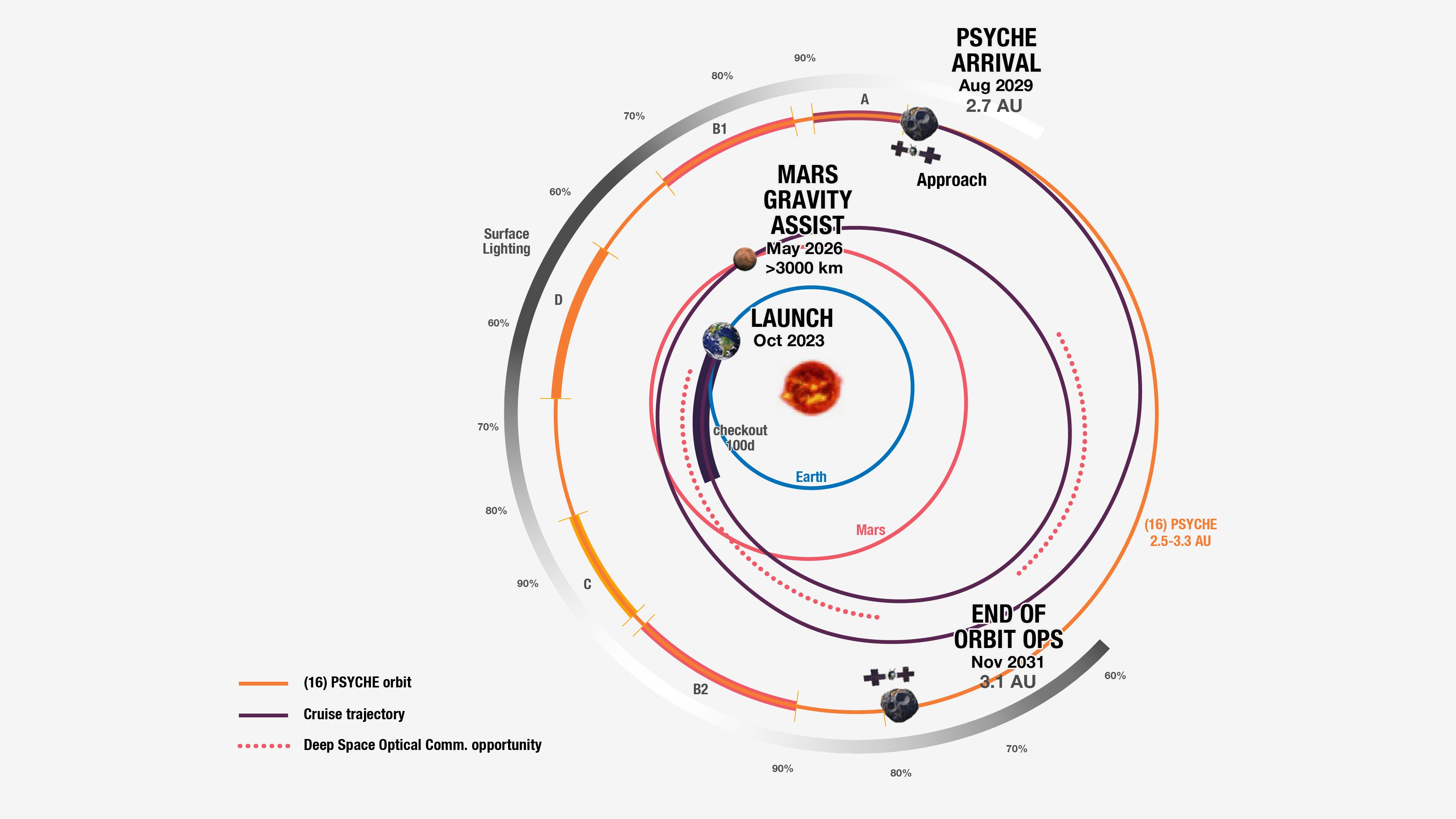
"Ultimately, though, the only reason for this flyby is to get a little help from Mars to speed us up and tilt our trajectory in the direction of the asteroid Psyche," said Lindy Elkins-Tanton, principal investigator for Psyche at the University of California, Berkeley.
"But if all our instruments are powered up, and we can do important testing and calibration of the science instruments, that would be the icing on the cake."
Spacecraft Psyche is expected to reach asteroid Psyche in August 2029 for an over two-year-long mission.