Culture and Society
 PUBLISHED
 2
2


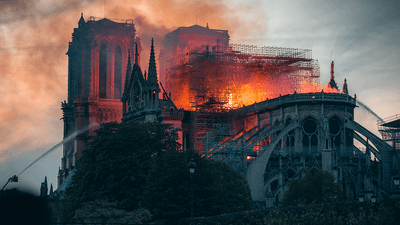


A team of archaeologists believes they have finally solved the mystery of the lead sarcophagi found beneath Notre-Dame Cathedral in Paris.
After the famous Cathedral burned to the ground in 2019, a number of incredible finds were made beneath the scorched ruins. Among them were two unusual lead sarcophagi, buried beneath the cathedral hundreds of years before, and separated by hundreds of years.
Carefully opening up the sarcophagi while wearing clothing to protect them from the lead, researchers from the University of Toulouse found the remains of two wealthy men, showing signs of a tough life. One of the bodies was easily identified, thanks to an epitaph that remained largely intact.
"THIS IS THE BODY OF MESSIRE ANTOINE DE LA PORTE CANOINE DE L'EGLISE," the epitaph helpfully read. "DECEASED ON 24 DECEMBER 1710 IN HIS 83RD YEAR. RESQUIETCAT IN PACE".
The coffin was made of lead to help preserve the body, a fate available only to the wealthy of the time – but unfortunately, the coffin was not intact and the body had decomposed significantly, leaving just the bones, hair, and a few fragments of textiles. His bones showed evidence of a sedentary lifestyle, as well as gout, a disease sometimes caused by eating and drinking to excess.
De la Porte was a canon, the team told Live Science, explaining his placement underneath a central part of the transept, reserved for the important. During his life he was influential and wealthy, commissioning several paintings that now hang in the Louvre, and paying to support the cathedral's choir.
The occupant of the second sarcophagus remained a mystery – until now, potentially. Early analysis showed the body appeared to be that of a 25- to 40-year-old male, who likely rode horses from an early age, judging by his pelvic bones.
The bones showed signs of chronic disease, while most of his teeth had been destroyed prior to his death. The aristocrat also showed signs of a deformed skull, likely from wearing a headdress or head band as a baby. As well as this, his body showed signs of reactive bone (the formation of new bone following injury), suggesting that the cause of death could be chronic meningitis resulting from tuberculosis. His skull had also been sawn off after his death, a common practice amongst the nobility in the 16th century.
Following further analysis, the team believes the body could belong to French poet Joachim du Bellay, who lived from 1522 to 1560. Du Bellay matches many of the features found on the body,
"Our attention was focused on Joachim du Bellay, a distinguished horseman and tubercular poet who died in 1560, whose autopsy revealed signs of chronic meningitis," the team from the National Institute for Preventive Archaeological Research (INRAP) explains in a statement. "Buried in the cathedral when he was no longer even a canon, his tomb was not found in 1758 near that of his uncle, although the family wanted him to be buried next to him."
Though the team believes the body belongs to du Bellay, a mystery still remains about how his body ended up where it did, given that it was recorded that du Bellay's body was buried in a side chapel.
"Two argued hypotheses are put forward," the team wrote, "a temporary burial that became permanent or a transfer of his coffin during another burial, in 1569, after the publication of his complete works."