Nature
 PUBLISHED




Microplastics are everywhere, causing disruption to hormones, crossing the blood-brain barrier in mice, and even being found inside the stomachs of the largest creatures on Earth. There's estimated to be 171 trillion bits of plastic pollution in the world's oceans. Even in remote locations microplastics persist in these extreme environments, and new research has learnt that microplastics have even been found inside algae growing under the sea ice in the Arctic.
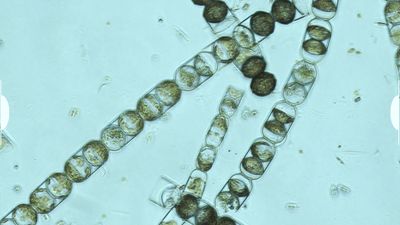
Melosira arctica is a type of ice algae found growing under the sea ice in the Arctic, from the Canada Basin across to northeastern Greenland. This is an important keystone species and feeds many types of zooplankton near the surface of the water. In the summer months the algae, which can form long sticky nets and ropes around 3 meters (9.8 feet) long, either floats freely or sinks to the ocean floor, where it provides food for seabed-dwelling creatures such as sea cucumbers and brittlestars.
Microplastics have been found in very high levels within the Arctic sea ice and the team wanted to see if the microplastics were ending up within the algae, and therefore spreading into the food chain when the ice melted and from the surrounding sea.
Samples were collected from within the Arctic circle from three locations in 2021. The samples were taken from M. arctica that were free-floating among the sea ice, and a sample was also taken of the surrounding seawater.
After analyzing the samples using Raman and fluorescence microscopy, the team found that all of them contained microplastics in concentrations ranging from 13,000 to 57,000 microplastics per cubic meter within the ice algae. In the seawater that was also sampled, the concentrations were from 1,400 to 4,500 microplastics per cubic meter. The algae had around ten times more microplastic particles than the surrounding seawater. Of the total microplastic particles that were found, 94 percent of them were 10 micrometers or smaller in size.
“The filamentous algae have a slimy, sticky texture, so it potentially collects microplastic from the atmospheric deposition on the sea, the sea water itself, from the surrounding ice and any other source that it passes. Once entrapped in the algal slime they travel as if in an elevator to the seafloor, or are eaten by marine animals,” explains Deonie Allen of the University of Canterbury and Birmingham University, who is part of the research team, in a statement.
Unfortunately the team believes that M. arctica is acting as a sink for microplastics. Given that these ice algae are fed upon by many creatures, both on the surface of the water and when the algae sinks to the seafloor, this indicates that the algae are a key vector in the transport of these microplastics to other organisms in the Arctic ecosystem.
The study is published in Environmental Science and Technology.