Space and Physics
 PUBLISHED




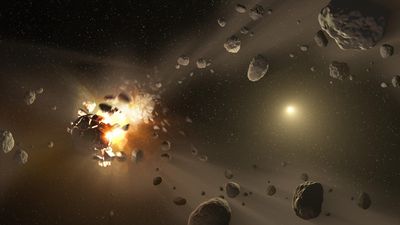


The metaphor writes itself. A cosmic breakup ends with rocks being flung at the goddess of love.
The former unity was between two asteroids, 2021 PH27 – the fastest in the solar system – and the recently discovered 2025 GN1. The latter has a remarkably close orbit to the former and orbits the Sun only marginally more slowly. So it seems likely that the two were once connected.
New research suggests another connection, one between these two asteroids and a possible Venusian meteor shower. If this is the case, it would be the second-known asteroid-caused event after the Earthly Geminids, caused by the very odd asteroid Phaethon.
Both asteroids take less than four months to orbit the Sun, and they belong to the rare Atira group, whose orbits lie entirely within Earth's own. Given that these asteroids are so close to the Sun and inside Earth’s orbit, it is very difficult to spot them.
The team established that both asteroids were a single body until not too long ago, astronomically speaking. The split occurred at least 10,500 years ago and maybe between 17,000 and 21,000 years ago, according to a simulation.
Breakups between objects in space are often caused by a third object. Collisions are good culprits, and so are tidal forces caused by the gravity of some celestial body. It seems there were no collisions here, though, and the original asteroid didn’t get close enough to Venus or the Sun to break up due to gravity.
It did, however, get close enough to the Sun to be broken apart by heat. And this is the crux.
The team believes the fracturing split the asteroid into two large bodies, 2021 PH27 and 2025 GN1, as well as countless tiny fragments, some as small as a grain of sand. As the asteroid moved around the Sun over the last many thousands of years, some of those grains likely reached Venus, where they will have burned up in the atmosphere.
"Considering that their orbits pass very close to Venus, it's natural to wonder whether very small fragments, on the order of a millimeter, generated by the breakup of the original body, could still be in orbit around the Sun," lead author Albino Carbognani, from the Instituto Nazionale di Astrofisica, Italy, said in a statement translated by IFLScience. "Our simulations confirm that this is indeed possible."
If that is the case, they could still be causing meteor showers on Venus. Such showers have previously been proposed explain flashes of light seen by orbiting spacecraft. Future missions might be able to properly link a meteor shower to these asteroids.
Asteroid 2025 GN1 frequently passes Venus, and in fact gets closer and closer every time. In about 2,000 years it will be within Venus's gravitational sphere of influence, and we don’t know how it will behave after that.
The paper is published in the journal Icarus.