Space and Physics
 PUBLISHED



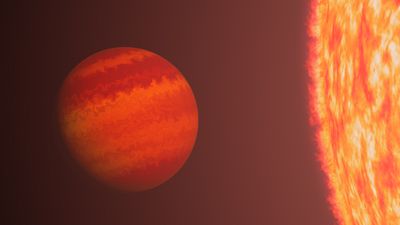


Astronomers have discovered a planet that has made them question both what we know about hot Neptunes and what the future of Earth might be like – not bad for a single object. The world is smaller, hotter, and older than scientists expected for its class.
It is called TIC365102760 b, but nicknamed Phoenix for reasons that will become evident soon. The world is six times close to its star than Mercury is to the Sun, and the star is not a small object but a red giant, the next phase in the evolution of stars like our Sun.
Being so close to its star makes it hotter, and both the temperature and the relentless stream of particles from the star should have stripped this planet of its atmosphere. The world is 6.2 times bigger than Earth, so in the Neptune-size category. Astronomers has seen bigger and younger planets losing their atmosphere due to similar proximity to their stars. But Phoenix seems to be the exception.
“This planet isn’t evolving the way we thought it would, it appears to have a much bigger, less dense atmosphere than we expected for these systems,” lead author Sam Grunblatt, a Johns Hopkins University astrophysicist, said in a statement. “How it held on to that atmosphere despite being so close to such a large host star is the big question.”
The planet was originally spotted by NASA’s Transiting Exoplanet Survey Satellite, and was further characterized by using the Keck Observatory. The properties reveal a world like no other. There are other hot Neptunes, but Phoenix is 60 times less dense than the densest among them.
“It’s the smallest planet we’ve ever found around one of these red giants, and probably the lowest mass planet orbiting a [red] giant star we’ve ever seen,” Grunblatt said. “That’s why it looks really weird. We don’t know why it still has an atmosphere when other ‘hot Neptunes’ that are much smaller and much denser seem to be losing their atmospheres in much less extreme environments.”
The atmosphere stripping here is going really slowly, and it will possibly survive the death of this planet. Red giants are large objects, extending for tens of millions of kilometers and even more. Their inflated size affect the orbit of planets, which might end up spiraling inward and be destroyed. That’s the fate of Phoenix about 100 million years down the line.
It is also the possible fate of Earth. In about 5 billion years, the Sun will expand and engulf Mercury, Venus, and likely even our world. This work suggest there might not be a single path for Earth to get there.
“We don’t understand the late-stage evolution of planetary systems very well,” Grunblatt said. “This is telling us that maybe Earth’s atmosphere won’t evolve exactly how we thought it would.”
A paper describing this discovery was published in The Astrophysical Journal.