Space and Physics
 PUBLISHED
 11
11


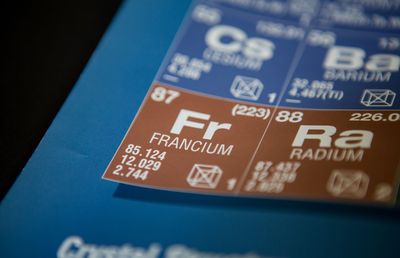


Take a look at the first column of the periodic table. The elements in this group include some of the most common and useful ones on the planet - and they probably all wish they weren’t associated with francium.
Sitting at the bottom of this row of chemical workhorses, this spectacularly radioactive element would be toxic to anyone who came near it, if only it could stop itself from vanishing. In fact, it's estimated that there’s never more than about 28 grams (1 ounce) of the stuff in Earth's crust at any given time, and no one has ever managed to obtain a weighable quantity of the elusive metal, let alone see it.
So while other alkali metals play key parts in important stuff such as batteries and cellular processes, francium has absolutely no known uses and doesn’t appear to play any biological function. It’s so rare and short-lived that scientists who want to study the element have to create their own by bombarding radium with neutrons or thorium with protons.
For many years, the very existence of francium was a matter of conjecture. It was Dmitri Mendeleev - the father of the periodic table - who first theorized that there might be an undiscovered alkali metal lurking somewhere in the universe with an atomic number of 87. This sparked a frantic and highly competitive quest to discover the hypothetical element, with numerous prominent scientists claiming to have found it, only to later have their results disproven.
As it happens, the metal’s only naturally-occurring isotope - francium-223 - forms during the radioactive decay of actinium. In 1939, it was detected for the very first time by a French woman named Marguerite Perey who worked with actinium at the Institut du Radium in Paris and had once served as Marie Curie’s personal assistant.
What had previously been known simply as “element 87” was subsequently renamed "francium" in honor of Perey’s home country, which also lends its name to the element gallium.
Observations made after its discovery revealed that francium-223 has a half-life of just 22 minutes, which means it takes this long for half of the atoms in a sample of francium to decay. For context, uranium-235 - a radioactive isotope used to fuel nuclear power plants - has a half-life of around 700 million years.
Given how radioactive it is, one can only imagine the havoc that francium could wreak on the human body. Fortunately, there’s so little of the stuff around that you don’t have to worry (unless you happen to work with it).