Nature
 PUBLISHED


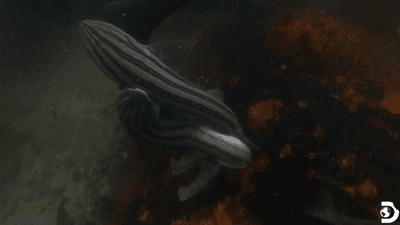


If you go down to the kelp forest today you’re sure of a big surprise – which is exactly what biologist Forrest Galante received when filming for a new TV show as part of Shark Week on Discovery. In a kelp forest off the coast of South Africa, Galante and the team managed to film pyjama sharks mating for the first time.
Pyjama sharks, so called because of their black and grey striped bodies, are a species of catsharks that can grow to roughly 1 meter (3.2 feet) long. They are only found in the warmer waters around the South African coast and reached pop culture as the villain in the Netflix documentary hit My Octopus Teacher.
While the team initially thought the sharks might be fighting, what they were actually seeing was the slightly aggressive advances of the male as he bites the side of the female. The sharks then reproduce by the male transferring a packet of sperm to the female via his claspers. The eggs are then fertilized inside the female. When they are laid, they are held in place with tendrils that become attached to the kelp fronds. After approximately five months the eggs will hatch and tiny 15-centimeter (5.9-inch) pyjama sharks will emerge according to the Save Our Seas Foundation website.
"I think we're the first ones to ever record [pyjama sharks mating]," Galante told Live Science. "Honestly, just seeing it… I'm getting goosebumps thinking about it because it was such an amazing experience to see this first hand."
Pyjama sharks are the latest species to join the getting jiggy on camera party – earlier this year, suspected courtship behavior was filmed for the first time in megamouth sharks, while whitetip sharks have also been spicing up the seas with their mesmerizing mating ritual.
The team thinks this reflects well on the whole kelp ecosystem as despite the threats that affect this underwater forest, the pyjama sharks are continuing to thrive here.