Space and Physics
 PUBLISHED


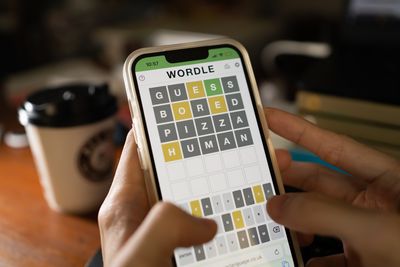


Every day, millions of people play their daily game of Wordle. All have their preferred tactics; their favorite starter words; some track their statistics obsessively, comparing themselves to friends and other players around the world. And, according to a new paper from researchers at Binghamton University, they’re all doing it wrong.
“In the full test, [our] entropy strategy guessed almost every secret word within six tries, achieving a success rate of over 99 percent,” reports the team, while a method based on the natural way most people play “guessed the word about 90 percent of the time.”
The new method was also faster: “On average, the entropy method found the secret word in fewer tries than the baseline,” the paper confirms. “These results show that the entropy-driven approach performs better than the letter-frequency approach.”
So, what’s the secret? Well, let’s go through the basics of Wordle.
It’s a pretty simple game: you have six guesses to figure out a random five-letter word, with each incorrect guess giving more clues as to what the answer actually is – a letter turning gray means it’s wrong; yellow means it’s right, but in the wrong place; green means it’s correct.
How would you start playing? For many players, the answer is obvious: choose a word with as many vowels as possible.
“The strategy seems to make sense: Figure out the vowels, and the other letters will fall into place,” wrote Josh Katz and Aatish Bhatia, two graphics editors at the New York Times who analyzed more than half a billion completed Wordle games back in 2023.
From there, the usual strategy is similarly seemingly logical: you keep the green letters where they are, you keep the yellow letters but shuffle them about a bit, and you replace the gray ones. The method obviously works – according to one analysis, only about four in every 300 players fail to get the answer at all – but can it be beaten? The Binghamton researchers say yes.
“A subtle but important insight […] is that a guess doesn’t have to be the most likely answer; it simply has to be informative,” said Donald Stephens, a doctoral student at Binghamton University and coauthor of the new paper, in a statement.
Rather than the orderly algorithm favored by human players, therefore, the team went chaotic – literally, using a mathematical measure of uncertainty known as Shannon entropy to figure out the optimal next step at each stage of the game.
“By applying Shannon entropy, the objective shifts to maximizing the expected reduction in uncertainty rather than the probability of being right,” explained Stephens. “In practice, this approach can lead to solving the puzzle in fewer guesses.”
It’s both smarter and not than the human technique. While you or I could never hold in our brains the entropy and potential information yield of hundreds of thousands of words, which the algorithm does, we are able to decide whether, say, ZYMIC or CRANE is more likely to turn up in a daily brainteaser solved by millions.
We’re also not likely to get stumped by a simple anagram, which can easily trip up the entropy method: “as an example, consider the letters of ‘stale’,” explains the paper. “This strategy could get stuck on one of the following words: ‘least’, ‘stale’, ‘slate’, or ‘steal’.”
For all that it gets caught out now and then, though, the new method does have the edge over your average human player – even if it’s not the best out there among computerized players.
“Exact search algorithms have achieved superior performance,” the paper points out; “for example, an optimal dynamic programming approach can guarantee solving any Wordle in at most five guesses, with an average of about 3.42 guesses using the best starting word.”
Still, the lesson is clear: if you want to solve Wordle as efficiently as possible, don’t go orderly. Go chaotic. As long as there’s method in the madness, you’ll probably get to the answer quicker.
The peer-reviewed study is published in the Northeast Journal of Complex Systems.