Space and Physics
 PUBLISHED
 5
5




A colossal solar storm that erupted in April last year completely obliterated part of the Earth’s magnetic field, morphing the planet’s magnetosphere and causing it to grow “wings”. As a result of this spectacular rare event, a two-way highway between the Sun and Earth temporarily opened up, sending charged particles in both directions and sparking auroras at both ends.
Describing the wild phenomenon in a new study, researchers explain that the Earth typically moves through the magnetized solar wind at a velocity that exceeds the so-called Alfvén speed, which denotes the speed at which magnetic waves travel through a plasma. The result, they say, is similar to that caused by “supersonically fast fighter jets creating sonic shocks in the air,” whereby the Earth’s super-Alfvénic motion produces what’s known as a bow shock.
In a series of posts on X about the event, NASA explains that a bow shock is “like the frothy waves at the front of a boat as it cuts through the water.”
Occasionally, however, low density plasma spewed out by the Sun in a kind of eruption called a coronal mass ejection (CME) can cause the Alfvén speed to exceed that of the solar wind. When this occurs, the bow shock disappears and the Earth’s magnetosphere loses its typical “windsock-like” shape, instead developing what are known as Alfvén wings.
According to the study authors, these wings magnetically connect our planet to the part of the Sun from which the CME erupted, acting as “highways for Earth's plasma to be lost to the Sun.”
And that’s exactly what happened on April 24, 2023, when an enormous CME caused auroras to become visible all the way down in the southern US. “At one point, while surrounded by the storm, a part of Earth’s magnetic “shield” briefly dissipated,” explained NASA in its X thread.
“With the bow shock (momentarily) gone, the magnetic field within the solar eruption — still rooted to the Sun — fused with Earth’s magnetic field,” continued the agency. “Particles trapped by Earth’s magnetism suddenly had an escape — a direct path to the Sun!”
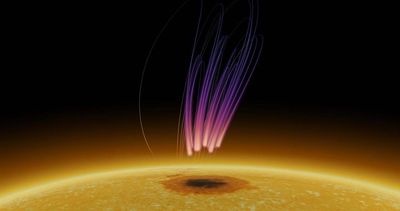
“In other words, the usual one-way flow from the Sun to Earth suddenly went both directions: For about two hours, Earth was also spewing particles back into the Sun!... If you had super-vision, you might even have witnessed an aurora on the Sun, as particles from our planet collided with the Sun’s atmosphere.”
ⓘ IFLScience is not responsible for content shared from external sites.
In reality, this solar aurora would have been far too dim to see against the brilliance of the Sun, but the rain of charged particles was detected by NASA’s Magnetospheric Multiscale (MMS) spacecraft, which flew threw the Earth’s Alfvén wings.
Despite being rare in our corner of the Solar System, Alfvén wings are actually pretty common elsewhere in the universe. In the realm of gas giants, for instance, these magnetic wings allow for charged particles to reach Jupiter from its moons Io and Ganymede, producing the enormous planet’s gorgeous ultraviolet auroras.
The study has been published in the journal Geophysical Research Letters.