Health and Medicine
 PUBLISHED
 1
1


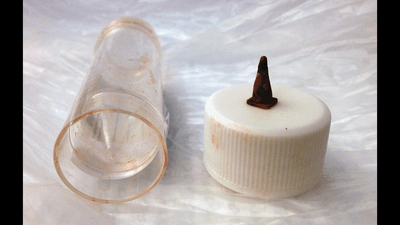


Ever had a cough that just wouldn't shift? You’ll have sympathy, then, for a man whose repeated respiratory infections went on for 16 years.
Following several treatment plants and procedures to drain fluid, further tests, including a CT scan, revealed that some kind of mass or fluid was lurking in the lower right lung. It appeared to be some kind of solid object, either a foreign body or calcified secretion, but then the doctors noticed something strange: “It looked like a toy traffic cone,” they wrote in the 2013 case study.
It’s fun to imagine how the conversation must have gone in the consultation room that day. No doubt it was a relief that when asked about it, the man recalled swallowing a toy traffic cone over 40 years ago when he was just 6 years old.
The theory had legs; the only problem now was figuring out how to get it out. Investigation with a flexible bronchoscopy (a thin, bendy camera that can go into your lungs) revealed it was unlikely they were going to be able to pull it out. So, it was decided they would perform a right lower lobectomy and cut away the affected part of the lung.
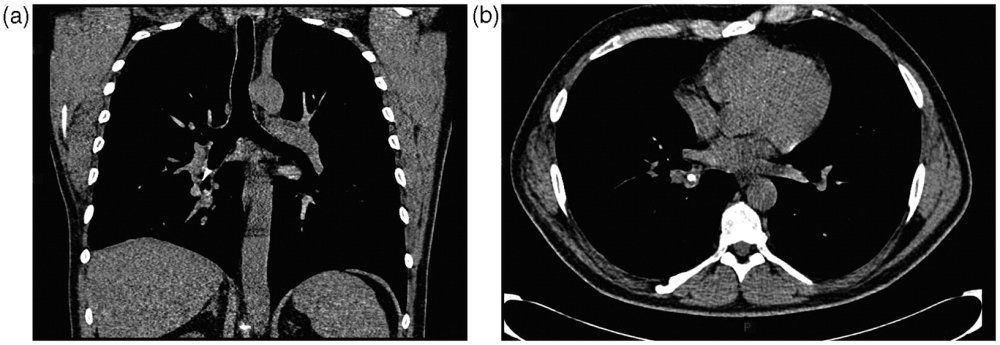
Though small, the cone had done some real damage during its 40-year stay inside the man’s right lung. The case study reveals that there were areas of tissue that had stuck together, forming adhesions as a result of the associated inflammation.
There was a lot of pus, too, but at last they found the traffic cone exactly where it had appeared on the CT scan. It was removed and the lung closed with stitches, and remarkably, the patient didn’t experience any postoperative complications. And better still, he got his little traffic cone back.
It’s a bizarre case study, but a sequence of events that isn’t unfamiliar to doctors.
“Foreign bodies can obstruct the tracheobronchial tree by migrating from distant sites such as the oesophagus,” wrote the case study authors. “These can escape detection due to inconsistencies in the clinical history. If the acute phase passes uneventfully, the child may progress to the second stage by being asymptomatic and develop chronic inflammatory changes and recurrent bouts of infection. This may progress to bronchiectasis and typically involves inorganic objects such as a toy traffic cone.”
And if you think a traffic cone is a strange thing to find in someone’s lung, just wait until you see what doctors spotted during a man’s colonoscopy…