Nature
 PUBLISHED


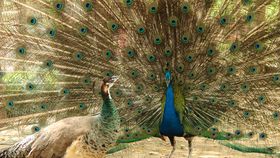


With all that extravagant plumage and feathery showmanship, you would think that male peacocks have an eye for the ladies. However, it turns out they spend most their time checking out the other guys instead.
Evolutionary biologists from Texas A&M University had the unenviable task of sticking GoPro-esque cameras onto the heads of 14 Indian peafowls during mating season in order to track their eye movements and line of sight and see who they were checking out. Their findings were recently published in the Journal of Experimental Biology.
The data showed that the male peacocks spent 27.9 percent of their time gazing at other male rivals, 43.4 percent gazing at the environment, and just 3.1 percent of the time looking at females. The remaining gaze data could not be analyzed due to errors with the cameras.
For the females, it was also all eyes on the males, with them exhibiting "strikingly similar gaze paths when evaluating a displaying male."
The majority of this gazing was directed at the lower part of the male's extravagant tail and lower "eyespots". The researchers believe this is the case because it serves as a good indication of the rival male’s, or potential mate's, body size. For the females, this is simply to see who is the best peacock to mate with. For the males, this "rival assessment" is to essentially suss out the competition (or so they say).
"We found that they are mostly looking at the lower portion of each other’s displays in a similar way that the peahens were assessing the males as mating partners," Jessica Yorzinski, one of the study's authors, told Reuters. Unsurprisingly, she also said that the hardest part of the study was trying to strap the cameras onto the bird's head.
Previous research has shown that males with longer trains are more successful in gaining territory and mates. "This work further supports that by showing the birds are looking at those traits and assessing the length and the width by scanning back and forth along the lower portion of the train," Yorzinski said.