Space and Physics
 PUBLISHED



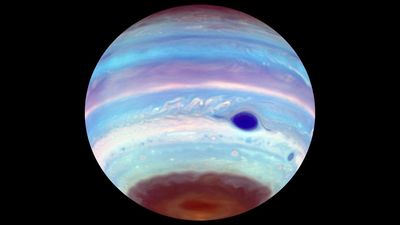


The Great Red Spot is not the only Earth-sized atmospheric disturbance seen on Jupiter. That dramatic storm remains number one for size and power in the Solar System, but ultraviolet (UV) observations from Hubble have now revealed that Earth-size ovals of haze are being stirred up over Jupiter's polar regions. The culprit is believed to be the planet's terrifyingly strong magnetic field, which is 20,000 times stronger than Earth’s own.
In images taken by Hubble between 2015 and 2022, dark UV ovals appear at the planet’s south pole 75 percent of the time. The work, led by Troy Tsubota and Michael Wong, suggests that these are caused by hazes and influenced by the strong magnetic field, which penetrates deep into the Jovian atmosphere. The dark ovals were first seen in the 1990s; between 1994 and 2022, eight ovals were seen in the southern polar region and two in the northern polar region.
“The haze in the dark ovals is 50 times thicker than the typical concentration which suggests it likely forms due to swirling vortex dynamics rather than chemical reactions triggered by high-energy particles from the upper atmosphere,” co-author Xi Zhang, from UC Santa Cruz, said in a statement. “Our observations showed that the timing and location of these energetic particles do not correlate with the appearance of the dark ovals.”
Zhang and fellow co-author Tom Stallard, from Northumbria University, are experts on planetary atmospheres. They think that the interaction between the magnetic field and the ionosphere – the layer of charged atoms surrounding the planet – as well as between the magnetic field and the volcanic material released by Io are involved. These two interactions create vortices due to friction, and those vortices force hazes to organize themselves in those vast ovals.
"Studying connections between different atmospheric layers is very important for all planets, whether it's an exoplanet, Jupiter or Earth," Wong said. "We see evidence for a process connecting everything in the entire Jupiter system, from the interior dynamo to the satellites and their plasma torii to the ionosphere to the stratospheric hazes. Finding these examples helps us to understand the planet as a whole."
The work was possible thanks to the Outer Planet Atmospheres Legacy (OPAL) project directed by Amy Simon, a planetary scientist at the NASA Goddard Space Flight Center and also co-author of the paper.
"In the first two months, we realized these OPAL images were like a gold mine, in some sense, and I very quickly was able to construct this analysis pipeline and send all the images through to see what we get," said Tsubota, who is in his senior year at UC Berkeley. "That's when we realized we could actually do some good science and real data analysis and start talking with collaborators about why these show up."
The study is published in the journal Nature Astronomy.