


 Space and Physics



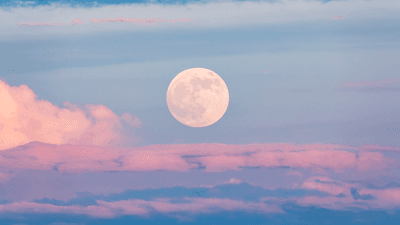


Once again, it's time to take your head and tilt it slightly towards the sky at night. We promise you'll be rewarded with a sight you won't see again for nearly 20 years, as well as a chance to see the infamous "moon illusion."
Tonight's moon, as you may have noticed by watching it throughout the month, is set to be a full one. If you've been keeping up with the Old Farmer's Almanac, you may also know that it's a strawberry moon.
Although there's a pretty good chance of a reddish moon tonight – more on that later – strawberry moons aren't named for their color but for the time of year they arrive. For Indigenous Americans, one's arrival likely signaled the time to harvest wild strawberries.
We'll be honest with you; though we enjoy a little history (and particularly the history of astronomy), this isn't the exciting bit, since strawberry moons are an annual event. But this month's full moon is a bit of a rarity in the grand scheme of things – and a feast for the eyes – due to where we are in the moon's 18.6-year cycle.
You are probably familiar with the solstice, the point in the year when the Sun reaches its highest or lowest point in the sky, resulting in the longest and shortest days of the year. This is due to Earth's 23.44° axial tilt with respect to its plane of orbit around the Sun, causing the Sun's position in the sky to shift by 47° between the summer and winter.
"The summer solstice occurs at the moment the earth's tilt toward/from the sun is at a maximum," the National Weather Service explains. "Therefore, on the day of the summer solstice, the sun appears at its highest elevation with a noontime position that changes very little for several days before and after the summer solstice."
This is where the word "solstice" comes from, with the original Latin "solstitium" meaning "Sun stands still." The Moon also has its own monthly "lunar standstills."
Now, if the Moon's orbit were on exactly the same plane as Earth's orbit, you would expect the Moon to rise and fall by the same amount as the Sun does. But that isn't the case (well, it is, but only on average), as the Moon itself is tilted relative to the solar plane by around 5.1°, bobbing below and above it by this amount on an 18.6-year cycle.
If you were to plot the position of the Moon for a long time (which, helpfully, some people do), you would find it rises higher at some points during this 18.6-year cycle and lower at others.
The least extreme angles between the highest and lowest points are seen at what is termed a "minor lunar standstill." Here, the Moon's highest and lowest points are closer together in the sky, and its lowest point is further from the horizon than at any other time in the cycle.
Then there is a "major lunar standstill." This is a little more exciting to any space fans out there, or fans of gawping at pretty sights in general. It is when the highest and lowest points the Moon reaches are at their most distant from one another, with the Moon straying closer to the horizon, where it is prettiest.
With more atmosphere to travel through, it could also earn the strawberry name thanks to a little Rayleigh scattering.
When light hits our atmosphere, light in the blue spectrum is scattered more efficiently than red light by particles it encounters. The more atmosphere the light has to travel through (for example, at sunset), the more blue light gets scattered, making the Sun or Moon appear yellower, or even red. Conversely, when the Sun or Moon is directly above you, it will appear whiter, as the blue light has less atmosphere to scatter through in order to reach your gawping eyeballs.
We aren't quite at a major lunar standstill; that happened in 2024 and was livestreamed from Stonehenge. Why Stonehenge? Well, it turns out that this knowledge may stretch back quite some time, with some evidence suggesting the henge may have been designed to capture lunistices as well as solstices.
"Happening only every 19 years or so, the major lunar standstill would have been a generational event – spoken about in the stories that passed orally from one generation to the next," English Heritage, which manages the ancient monument, writes of the topic.
"The phenomenon may have marked huge celebrations of religious, spiritual and social significance, and perhaps also mark the time for the rites of initiation of young members of the community into adulthood."
We are now moving away from the major lunar standstill and towards a minor lunar standstill, which will occur in 2034. With the next major lunar standstill in 2043, you won't see the Moon so low on the horizon for quite some time, making it the perfect opportunity to check out (or solve if you are more ambitious) the infamous Moon illusion. If you miss it, next month's will be ever so slightly less good.


 1
1