Space and Physics
 PUBLISHED





Before last year, the longest radio burst from the Sun lasted five days. Now, thanks to multiple spacecraft observing our star, researchers have discovered one almost four times as long. Lasting 19 days – from August 21 to September 9 – this record-breaking event came as a complete surprise to scientists.
It was first observed by the European Solar Orbiter, a mission that last year delivered the first images of the poles of the Sun. Then, 12 days later, it was seen by NASA’s Wind, a spacecraft that studies the stream of particles released by the Sun, and by NASA’s Parker Solar Probe, a mission that regularly gets as close to the Sun as we possibly can. Last but not least, a day later, NASA's STEREO-A spotted this radio emission as well, which appeared to be co-rotating with our star.
This is known as a Type IV burst, and it's completely harmless, unlike many other solar events. The mechanism of how it's produced can remind people of radio waves emitted by telecommunication devices. You have electrical currents moving electrons back and forth, and this motion produces radio waves, which spread through space.
The Sun is made of plasma; the nuclei of its atoms (mostly just protons from hydrogen) are enmeshed within a sea of electrons. Magnetic fields and electric currents shape the motion of these charged particles when they reach the outer regions of the Sun, and, in the case of a Type IV burst, a reservoir of electrons trapped within the Sun’s magnetic field produces radio waves.
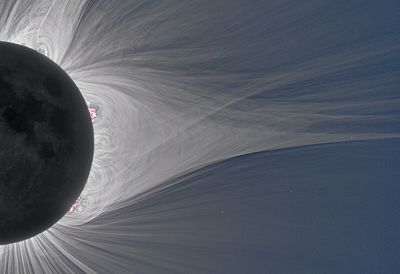
But how did the reservoir form in the first place? Researchers developed a new technique that uses the STEREO-A data as a tracker. With that, they confirmed that the burst was produced by a large magnetic feature in the solar corona – the Sun’s atmosphere – known as a helmet streamer. These are funnel-shaped structures that are visible around the Sun during an eclipse.
The reservoir of electrons appears to have been filled up by three powerful coronal mass ejections, enormous outbursts of plasma from the Sun, that happened across the same region. Coronal mass ejections can be damaging to technology on Earth, and monitoring them and other solar events is a crucial part of space weather forecasting.
This new insight into type IV radio bursts, which are possibly connected to the period of maximum activity of the Sun, as well as the ability to track them to their origin, could be a valuable tool to improve our understanding of space weather even though these events pose no direct threat to us.
The findings were published in The Astrophysical Journal Letters.