Nature
 PUBLISHED


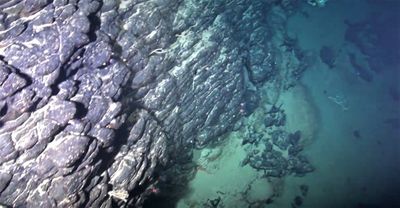


An enormous ancient island that now lies at the bottom of the Atlantic Ocean may hold vast reserves of rare earth elements and other valuable minerals. Known as the Rio Grande Rise (RGR), the submerged continental plateau formed as a volcanic ridge around 40 million years ago and was once a large tropical landmass covered with vegetation.
Located some 1,200 kilometers (745 miles) off the coast of Brazil, the RGR covers around 150,000 square kilometers (58,000 square miles) of seafloor at depths ranging from 700 to 2,000 meters (2,300 to 6,560 feet). The idea that the ridge may once have been an island was first floated in 2018, and has now been confirmed thanks to a new analysis of soils dredged from the western RGR.
Assessing the mineralogical, geochemical, and magnetic properties of the sediment, the study authors reveal that the sample is primarily made up of red clay that matches the characteristic “red earth” (terra roxa) found in many parts of São Paulo state. Within the soil, the researchers detected numerous minerals that are typical of volcanic rock alterations, including oxidized magnetite, hematite, goethite, and kaolinite.
Taken together, these findings indicate that the clay had formed as a result of intense chemical weathering of volcanic rocks in a warm, wet climate with active volcanoes. Based on this analysis, the researchers conclude that the RGR was exposed to the elements during the Eocene, which lasted until about 35 million years ago and was characterized by tropical conditions.
“Our research and analysis enabled us to determine that it was indeed an island,” explained study author Luigi Jovane in a statement. “Geologically speaking, we discovered that the clay was formed after the last volcanic activity occurred 45 million years ago. The formation therefore dates from between 30 million and 40 million years ago. And it must have been formed as a result of these tropical conditions,” he adds.
Prior research has also revealed that the submerged island is rich in valuable minerals such as cobalt, lithium, and nickel, as well as highly-prized rare earth elements like tellurium. Given that these materials are key components of the new technologies leading the transition away from fossil fuels, there is understandably a great deal of interest in extracting the RGR’s natural riches.
Situated in international waters, the ridge is currently governed by the International Seabed Authority, although the Brazilian government has applied for its own continental shelf to be legally extended to include the RGR. In reality, such an application has little chance of being approved, as the UN Convention on the Law of the Sea (UNCLOS) stipulates that a nation may own no more than 200 nautical miles of marine territory beyond its coastline.
“To know whether resources can be viably extracted from the seafloor, we need to analyze the sustainability and impacts of this extraction,” says Jovane. “When you interfere with an area, you have to know how this will affect animals, fungi and corals, and understand the impact you’ll have on the cumulative processes involved,” he says.
The study is published in the journal Scientific Reports.