Technology
 PUBLISHED
 1
1


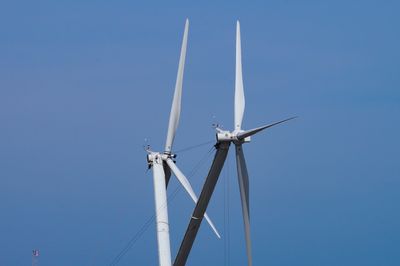


A newly launched floating platform will trial a novel way around the challenges of harvesting the wind over deep waters, putting two giant 8.3-megawatt (MW) turbines in a V formation. This enables a combined power greater than any existing floating turbine, or indeed any wind platform in widespread use.
Offshore wind provides a small percentage of the total wind energy in the world, but it is rising fast. Winds tend to be stronger and steadier offshore than over land, where surface roughness gets in their way. Moreover, the increasingly long blades used in a quest for greater efficiency can be very difficult to transport by road; ships have no such problems for offshore installation.
However, waters deep enough for ships to install turbines, but shallow enough for towers of practical height, are only extensive in a few places. Floating wind turbine platforms have become the next frontier. These can be anchored in much deeper water. Although they are more expensive to build, the hope is that the stronger winds they will harvest, and the wider opportunities allowing greater mass production, will eventually make floating wind farms the cheapest source of wind energy.
We may need some innovations to get there, however, which is where the OceanX by Mingyang Smart Energy comes in – although it might have been more appropriate to call it the OceanY, given its shape.
Some wind power experts are questioning the size race for ever bigger turbines, but Mingyang are clearly not among them. They are one of two companies with 18-MW wind turbine models, the world’s largest, in testing, They’ve also revealed plans for even larger models.
Mingyang is also the company behind the largest current mass deployed wind turbines, at 16 MW; its hub sits at 152 meters (500 feet) above the water and is driven by blades 123 meters (403 feet) long.
The stresses such long blades must resist are enormous, however. Using two smaller turbines, it is theoretically possible to get a similar amount of power out of a single mooring without needing such long blades.
The two turbines spin in opposite directions, so the forces they transmit to the rest of the system balance each other, a little like the counter-spin of helicopters’ two sets of rotors. Cables to three floating arms provide extra stability.
Although there's nothing on their website at the time of writing, according to Mingyang’s LinkedIn page, the OceanX is “capable of producing 54 million kWh annually, sufficient to power 30,000 households.” That’s a capacity factor of 37 percent, well below what the biggest offshore turbines in the North Sea manage. Whether this reflects lower wind reliability in the South China Sea, where the OceanX is to be deployed, or indicates there is some downside to the design, is not clear.
Mingyang also advertises a “Single-Point Mooring: An adaptive system that ensures stability and safety even in extreme typhoon conditions,” adding, “Breaking barriers in offshore wind, Mingyang's OceanX heralds a new dawn in marine energy. Join the celebration and let's charge into a sustainable future together!”
Although much smaller prototypes of the design have been trialed, the functionality of the OceanX still needs to be tested in real world conditions before mass deployment begins. Comments on the post ask how it will respond to rapid changes of wind direction during a typhoon, and whether it will yaw in a full circle if faced with conditions that require it.